
The Punjab Government is introducing a groundwater recharging pilot project for 2026–27 to address two major challenges facing the province’s agricultural sector: declining groundwater levels and waterlogging caused by excessive rainfall. Through this initiative, the Punjab Agriculture Department plans to construct 1,000 groundwater recharge systems using borehole technology in selected agricultural areas.
The groundwater recharging pilot 2026 aims to help farmers manage excess rainwater, reduce crop damage and improve the natural replenishment of underground water resources. Under the announced cost-sharing arrangement, the government will provide a 70% subsidy, while participating farmers will contribute the remaining 30% of the system’s cost. The initiative is an important step towards improving agricultural water management and promoting sustainable farming in Punjab. It is one of several new Punjab government schemes announced for the coming year.
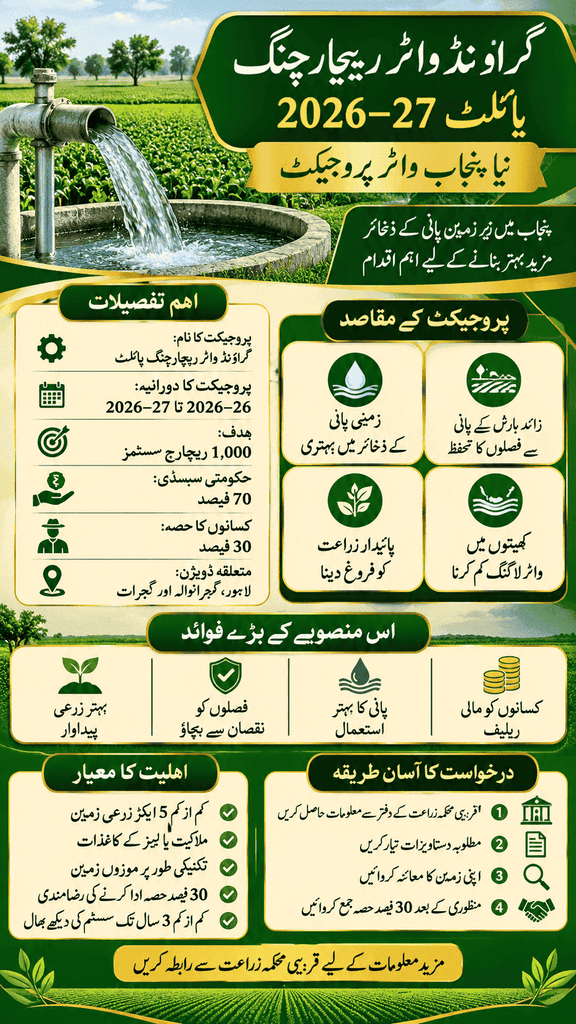
Groundwater Recharging Pilot 2026–27: Key Information
| Project Details | Information |
|---|---|
| Project Name | Groundwater Recharging Through Borehole Systems in Agricultural Fields |
| Programme Type | Pilot Project |
| Province | Punjab, Pakistan |
| Implementing Department | Punjab Agriculture Department |
| Project Period | 2025–26 to 2026–27 |
| Main Target | 1,000 groundwater recharge systems |
| Government Subsidy | 70% |
| Farmer Contribution | 30% |
| Total Project Cost | Rs. 730 million |
| Target Locations | Lahore, Gujranwala and Gujrat divisions |
| Main Objective | Groundwater recharge and protection against crop damage from flooding |
| Beneficiaries | Eligible individual farmers and farmer groups |
| Official Website | Punjab Agriculture Department |
Note: The Agriculture Department’s project page lists Rs. 730 million as the total project cost. Its newer 2026–27 new-schemes listing separately shows Rs. 801 million as the annual allocation. These are different budget figures and should not be treated as interchangeable.
What Is the Punjab Groundwater Recharging Pilot Project 2026–27?
The Groundwater Recharging Pilot 2026 is an agricultural water management initiative designed to improve the use of excess rainwater and support underground water reserves.
Under this project, groundwater recharge systems will be constructed through boreholes in selected agricultural fields. These systems are intended to collect suitable excess surface water and direct it into underground water-bearing layers, where it can contribute to natural groundwater replenishment.
The project is particularly relevant for farming areas where heavy rainfall creates standing water in agricultural fields while groundwater extraction continues to put pressure on underground water reserves.
The Punjab Agriculture Department has included this initiative in its development programme for the 2025–26 to 2026–27 period. Its planned target is to establish 1,000 groundwater recharge systems with financial support from the provincial government.
Main Objectives of the Groundwater Recharging Pilot 2026
The project focuses on improving water management and protecting agricultural land. Its major objectives include the following.
1. Reducing Waterlogging in Agricultural Fields
Heavy rainfall can cause water to accumulate in agricultural fields, particularly in areas with poor drainage. Prolonged waterlogging can damage crops, affect soil conditions and reduce agricultural productivity. Groundwater recharge boreholes are intended to provide another route for managing suitable excess surface water, helping reduce the impact of water accumulation.
2. Improving Underground Water Resources
Groundwater is an important source of irrigation for farmers across Punjab. Excessive extraction without sufficient natural replenishment can gradually reduce underground water availability. The project aims to return suitable surface water to underground aquifers and support more sustainable groundwater management.
3. Protecting Crops from Flood Damage
Standing water can negatively affect crop growth, especially when fields remain flooded for extended periods. By improving drainage at technically suitable locations, the project aims to reduce the risk of crop damage during heavy rainfall.
4. Promoting Sustainable Agriculture
The initiative encourages better water management practices and supports the long-term sustainability of agricultural resources. It also highlights the importance of using rainwater more effectively instead of allowing suitable excess water to go unused.
Which Areas Are Included in the Groundwater Recharging Pilot?
According to the Punjab Agriculture Department, the pilot project will be implemented in three divisions:
| Division | Project Coverage |
|---|---|
| Lahore Division | Selected eligible agricultural areas |
| Gujranwala Division | Selected eligible agricultural areas |
| Gujrat Division | Selected eligible agricultural areas |
The project is designed for agricultural fields where groundwater recharge systems can be installed at technically suitable locations.
Farmers should confirm whether their particular district and agricultural land are included in the implementation plan through their relevant Agriculture Department office. Inclusion of a division does not automatically mean that every farmer within it qualifies.
Government Subsidy and Farmer Contribution
One of the most important features of this project is its 70:30 cost-sharing arrangement. The Punjab Government will cover 70% of the approved cost of each groundwater recharge system, while the selected farmer will contribute 30%. This financial support is intended to make groundwater recharge technology more accessible to farmers.
| Financial Support | Percentage |
|---|---|
| Punjab Government Subsidy | 70% |
| Farmer Contribution | 30% |
| Total Approved System Cost | 100% |
How Does the 70% Subsidy Work?
For example, if the approved cost of a recharge system is Rs. 100,000:
- Government contribution: Rs. 70,000
- Farmer contribution: Rs. 30,000
- Total installation cost: Rs. 100,000
Illustrative example only. The actual cost per system and farmer payment will depend on the approved project estimate.
The subsidy is intended to reduce the financial burden on participating farmers and encourage investment in better water management infrastructure.
Eligibility Criteria for Groundwater Recharging Pilot 2026–27
Farmers interested in participating must meet the eligibility and selection conditions published by the Punjab Agriculture Department. The official project information identifies the following requirements:
1. Individual Farmers and Farmer Groups
Both individual farmers and groups of farmers are eligible to participate, subject to the project’s selection requirements.
2. Minimum Agricultural Land Requirement
Applicants must own, lease or cultivate agricultural land measuring at least five acres. The required land ownership or tenancy documents must be provided:
- Landowners must attach a Fard-e-Malkiyat obtained through the Land Records Management Information System (LRMIS).
- Lessees and tenants must provide an appropriate tenancy or lease agreement.
3. Suitable Land for Construction
Applicants must be willing to provide the required agricultural land at a technically feasible location for constructing the groundwater recharge system. The proposed location must meet the department’s technical requirements.
4. Agreement With Department Specifications
Selected farmers must agree to construct the groundwater recharge system according to the design, standards and technical specifications approved by the Agriculture Department.
5. Farmer’s Financial Contribution
Applicants must agree to pay their 30% share of the total approved system cost.
6. Maintenance Responsibility
Farmers must agree to maintain the groundwater recharge system for at least three years after its construction.
These conditions are based on the Agriculture Department’s published project criteria.
Required Documents for Participating Farmers
Farmers should prepare their land and identity documents before approaching the relevant Agriculture Department office. The following documents may be required during the selection and verification process:
| Document | Purpose |
|---|---|
| CNIC | Applicant identification |
| Fard-e-Malkiyat | Land ownership verification |
| Lease or tenancy agreement | Proof of agricultural land tenancy |
| Agricultural land details | Verification of minimum land requirement |
| Contact information | Communication with the applicant |
| Farmer group details | Required where applying as a group |
Important: The department’s published criteria specifically identify land ownership or tenancy documentation. The complete application-document checklist should be confirmed with the relevant district Agriculture Department office before submission.
How Does the Groundwater Recharge Borehole System Work?
The project uses borehole technology to help move suitable excess surface water into underground water-bearing formations. Unlike conventional methods, which keep rainwater in open ponds or reservoirs, a groundwater recharge borehole provides a pathway for water to enter suitable underground layers. The general process involves the following stages:
Step 1: Collection of Excess Rainwater
Rainwater accumulating in selected agricultural areas is directed towards a designated collection point.
Step 2: Water Filtration
Suitable filtration and sediment-control arrangements help remove soil particles and other unwanted materials before water enters the recharge structure.
Step 3: Underground Water Recharge
The collected water passes through the recharge borehole and reaches suitable underground formations, where it can contribute to aquifer replenishment.
Step 4: Regular Inspection and Maintenance
The system needs periodic inspection to prevent blockages and maintain effective operation.
Note: These are general operating principles of groundwater recharge technology. The final borehole design, filtration arrangements and construction specifications must follow the Agriculture Department’s approved technical plan.
Major Benefits of the Punjab Groundwater Recharge Project
The initiative has the potential to provide several benefits to farmers and the agricultural sector.
- Better Management of Rainwater: The project aims to make productive use of suitable excess rainwater by directing it towards underground water resources.
- Reduced Risk of Crop Damage: Improved drainage can help reduce prolonged water accumulation in selected agricultural fields, potentially protecting crops from waterlogging.
- Support for Groundwater Conservation: Groundwater recharge can help support underground water reserves and improve long-term water management.
- Financial Relief Through Government Subsidy: The 70% government contribution can reduce the initial financial burden on selected farmers.
- Improved Agricultural Water Management: The initiative promotes more effective management of rainfall, agricultural drainage and underground water resources.
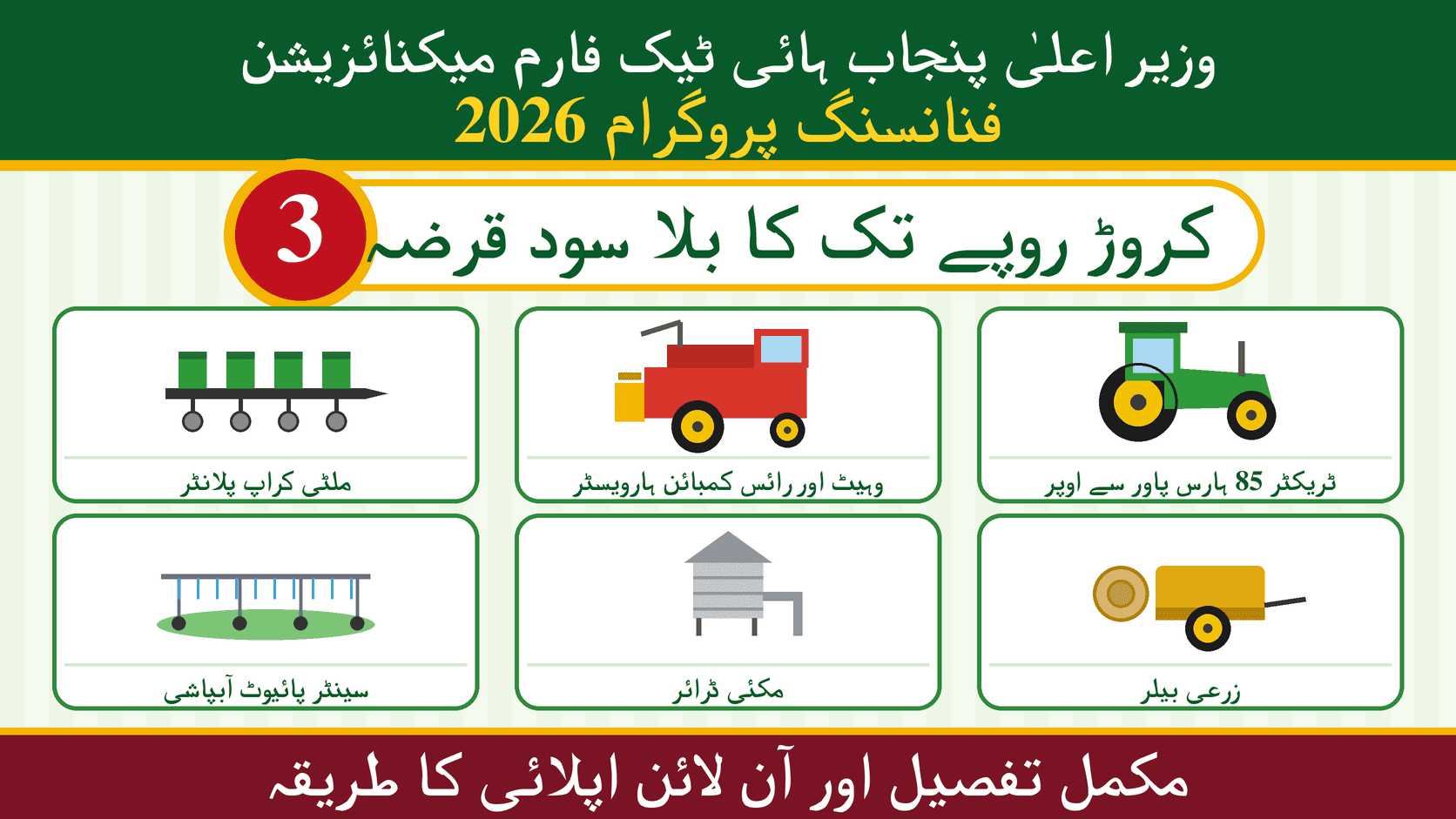
- Support for Climate-Resilient Agriculture: Better water management infrastructure can help farmers prepare for changing rainfall patterns and extreme weather conditions. Farmers planning to upgrade their equipment as well can read our guide on the Hi-Tech Farm Mechanization Program 2026 machinery loan.
These are the intended and potential benefits of the project. Actual results will depend on local soil conditions, groundwater geology, water quality, system design and maintenance.
Groundwater Recharge Project vs. Traditional Rainwater Storage
Groundwater recharge systems and conventional rainwater storage structures serve different purposes.
| Feature | Recharge Borehole | Traditional Storage Pond |
|---|---|---|
| Main Purpose | Replenishing underground water | Storing water above ground |
| Water Location | Underground aquifer | Surface storage |
| Land Requirement | Generally smaller footprint | Requires open land |
| Evaporation | Lower after water enters underground formations | Water is exposed to evaporation |
| Main Use | Supporting groundwater recharge | Storing water for later use |
| Maintenance | Requires inspection and filtration | Requires cleaning and pond maintenance |
The appropriate system depends on local conditions and the intended water-management objective. Recharge boreholes are not suitable for every agricultural location.
How to Apply for the Groundwater Recharging Pilot 2026–27?
Farmers interested in this project should contact the relevant Agriculture Department office to obtain information about the current application and selection process. The following steps can help applicants prepare.
Step 1: Check Your Eligibility
Make sure you meet the minimum five-acre agricultural land requirement and can provide the necessary ownership or tenancy documents.
Step 2: Contact the Agriculture Department
Visit your relevant district Agriculture Department office and ask about the groundwater recharge pilot and its current implementation arrangements.
Step 3: Prepare Your Land Documents
Arrange your CNIC, Fard-e-Malkiyat or tenancy agreement and any other documents requested by the department.
Step 4: Get Your Land Assessed
The proposed site must be technically suitable for installing a groundwater recharge system. Follow the department’s instructions regarding site inspection and approval.
Step 5: Confirm Your Financial Contribution
Ask the department to provide the approved cost estimate and confirm your 30% contribution before agreeing to participate.
Step 6: Follow the Official Selection Process
Submit your application or required documents through the officially designated process. Wait for verification and selection confirmation before making any payment or starting construction.
Official Information and Updates
For official project details, eligibility requirements and implementation updates, visit the Punjab Agriculture Department official project page.
At the time of writing, no separate online application portal or registration deadline has been announced in the official information reviewed. You can also browse more guides in our Agriculture Schemes section for updates on other farmer programmes.
Important Instructions for Farmers
Before participating in the Groundwater Recharging Pilot, keep the following points in mind:
- Confirm eligibility through the relevant Agriculture Department office.
- Make sure your agricultural land meets the minimum five-acre requirement.
- Provide genuine ownership or tenancy documents.
- Confirm that your proposed site is technically suitable.
- Understand the approved installation cost and your 30% contribution.
- Follow the official construction and maintenance requirements.
- Keep copies of all submitted documents and payment receipts.
- Avoid unauthorized agents who promise guaranteed selection or demand unofficial fees.
Frequently Asked Questions (FAQs)
What is the Groundwater Recharging Pilot 2026–27?
It is a Punjab Government agricultural initiative that aims to construct groundwater recharge systems through boreholes in farmers’ fields to improve groundwater replenishment and help manage excess rainwater.
How many groundwater recharge systems will be constructed?
The project targets the construction of 1,000 groundwater recharge systems in selected agricultural areas.
How much subsidy will farmers receive?
The Punjab Government will provide a 70% subsidy on the approved cost of each system. Participating farmers must contribute the remaining 30%.
Which areas are included in the project?
The published project information identifies Lahore, Gujranwala and Gujrat divisions as the implementation areas.
What is the minimum land requirement?
Applicants must own, lease or cultivate at least five acres of agricultural land and provide the relevant ownership or tenancy documentation.
Can tenant farmers apply for this project?
Yes. The published eligibility criteria include landowners, lessees and tenants. Tenant applicants must provide the required tenancy or lease agreement.
Is online registration available for the Groundwater Recharging Pilot?
The reviewed official project information does not provide a confirmed online application portal. Farmers should contact their district Agriculture Department office for the current application procedure.
How much does a groundwater recharge system cost?
The exact per-system cost is not specified in the published project information. The farmer’s contribution will be 30% of the approved system cost.
Is the project available throughout Punjab?
No. The published pilot locations are Lahore, Gujranwala and Gujrat divisions. Farmers should verify their district’s inclusion with the department.
How long must farmers maintain the system?
According to the official eligibility criteria, participating farmers must agree to maintain the groundwater recharge system for at least three years.
Conclusion
The Groundwater Recharging Pilot 2026–27: New Punjab Water Project is an important initiative aimed at addressing groundwater depletion and waterlogging challenges in Punjab’s agricultural sector. Through the planned construction of 1,000 groundwater recharge systems, the project seeks to improve rainwater management, support underground water reserves and reduce the risk of crop damage caused by excessive rainfall.
The 70% government subsidy makes the groundwater recharging pilot 2026 financially attractive for eligible farmers, while the 30% contribution encourages participation and shared responsibility. However, successful implementation will depend on proper site selection, technical construction, water filtration and regular maintenance.
Farmers in Lahore, Gujranwala and Gujrat divisions who meet the eligibility requirements should contact their relevant Agriculture Department office for updated application instructions and project details. They should also rely on official government information and avoid unauthorized registration agents. For other rural initiatives, you can also read about the Apna Gaon Programme 2026 village development plan.