

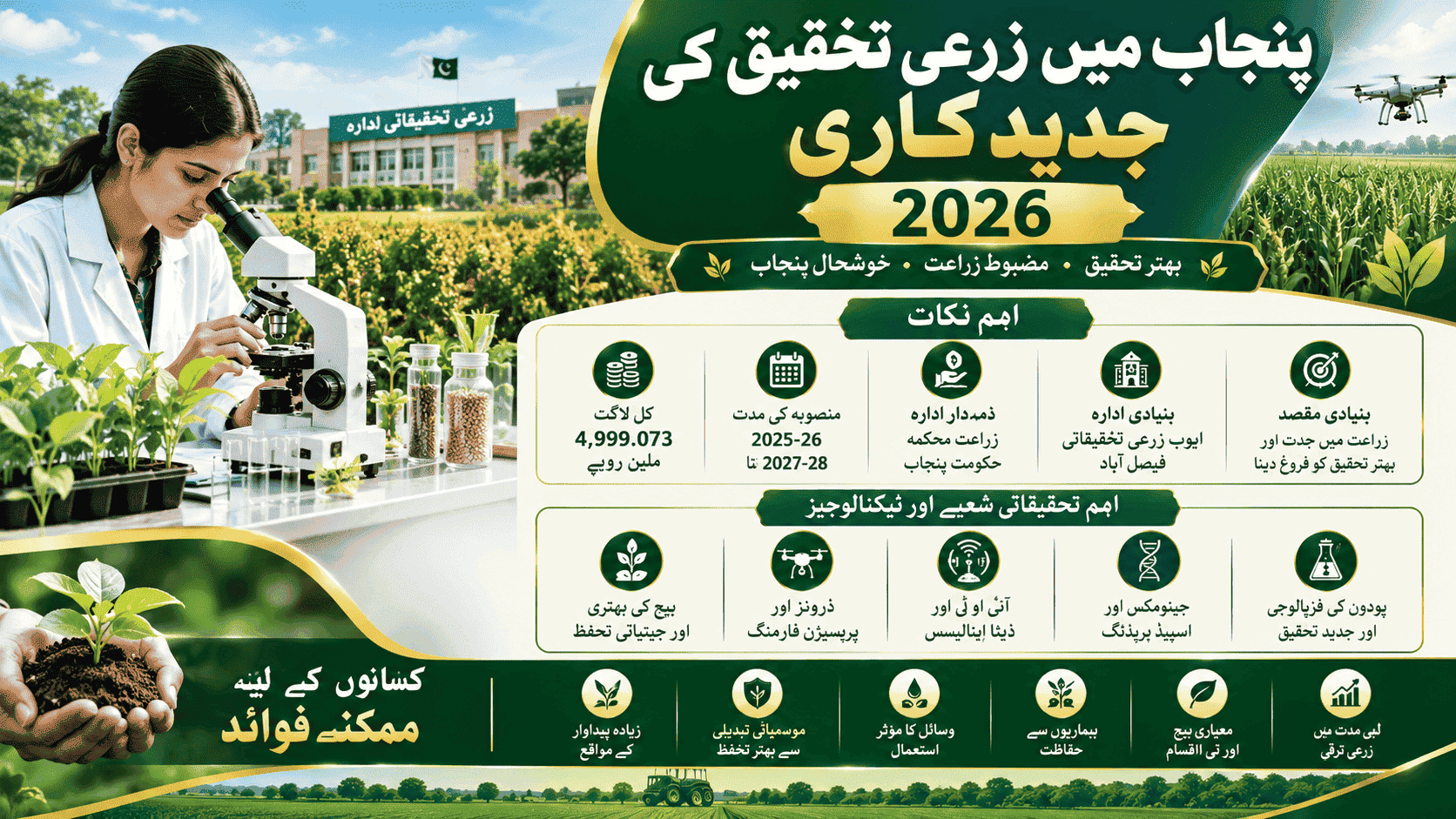
Punjab’s agriculture sector plays a vital role in food production, employment, and economic development. To strengthen this sector, the Government of Punjab has introduced the Revamping of Agricultural Research in Punjab project for 2025–26 to 2027–28. The initiative focuses on modernizing agricultural research, improving scientific facilities, introducing advanced technologies, and developing crop varieties that can better withstand climate-related challenges.
The project aims to strengthen the Ayub Agricultural Research Institute (AARI), Faisalabad, by integrating technologies such as genomics, speed breeding, artificial intelligence (AI), the Internet of Things (IoT), and agricultural drones. These improvements are intended to help researchers develop innovative farming solutions, improve crop productivity, and promote more efficient use of agricultural resources.
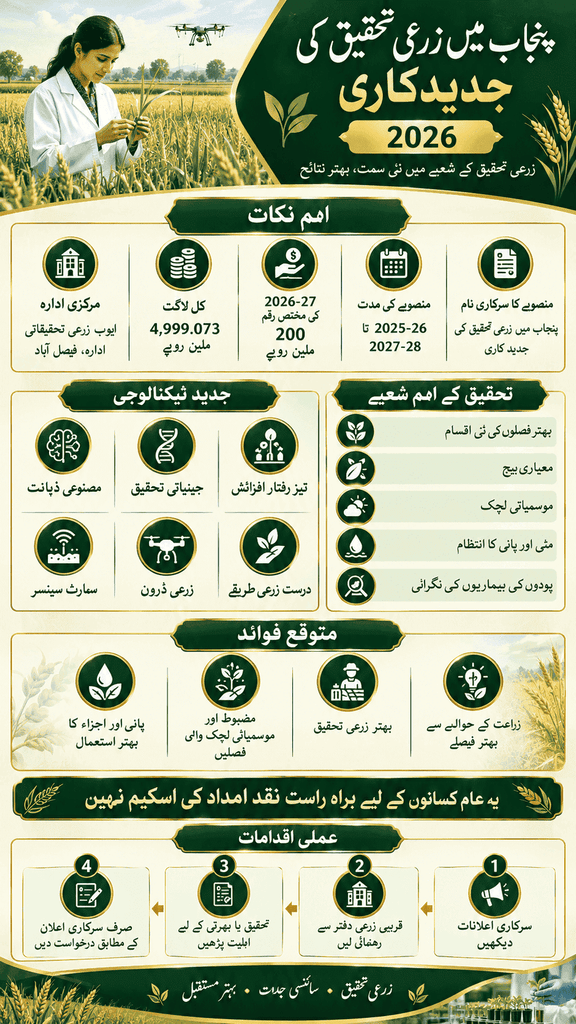
The total project cost is approximately Rs. 4.999 billion, while the listed allocation for the 2026–27 financial year is Rs. 200 million. This is a research-development initiative, not a general cash-assistance or subsidy scheme for farmers.
Punjab Agricultural Research Reforms 2026 – Key Information
Note: The total project cost represents the overall planned cost, while the annual allocation relates to a specific financial year. Neither amount should be interpreted as money available for direct distribution among farmers.
What Is the Punjab Agricultural Research Revamping Project?
The Punjab Agricultural Research Revamping Project is a government initiative intended to improve the province’s agricultural research capabilities. It focuses on strengthening research infrastructure, introducing advanced scientific equipment, and adopting modern methods for developing improved crops.
Agricultural research helps scientists understand how crops respond to different growing conditions, identify disease-resistant varieties, improve seed quality, and develop farming practices that use resources more efficiently.
Under this project, the government aims to modernize agricultural research by combining established scientific methods with advanced technologies. The initiative also seeks to improve research capacity and encourage collaboration to develop solutions suited to Punjab’s agricultural needs.
The project is particularly relevant because farmers face several challenges, including changing weather conditions, crop diseases, water shortages, soil degradation, and rising production costs. Research-based solutions may help address these problems over time.
Major Changes Under Punjab Agricultural Research Reforms 2026
The project covers several areas of research modernization. These components are designed to improve scientific capabilities and support the development of practical agricultural solutions.
1. Modernization of Agricultural Research Facilities
One of the main objectives is to modernize agricultural research at AARI Faisalabad. The project includes plans for a Centre for Innovative Agriculture Research and the procurement of advanced equipment for specialized agricultural research.
Modern facilities can help researchers conduct experiments more accurately, evaluate crop varieties, and study agricultural problems using improved scientific methods.
The planned improvements are expected to support:
- Better laboratory and research capabilities.
- More effective crop testing and evaluation.
- Improved scientific analysis of agricultural problems.
- Research into innovative farming technologies.
- Stronger coordination between scientific research and practical agriculture.
These improvements are intended to strengthen the foundation for agricultural innovation in Punjab. Their effectiveness will depend on successful implementation, appropriate staffing, equipment maintenance, and continued research funding.
2. Development of High-Yielding and Climate-Resilient Crops
Crop productivity depends on several factors, including seed quality, soil conditions, irrigation, temperature, and disease resistance. Climate change can make these factors more difficult to manage.
The research project aims to support the development of crop varieties with improved productivity, stress tolerance, and resource efficiency.
Research priorities include:
- Developing improved crop varieties for local growing conditions.
- Studying tolerance to heat and other environmental stresses.
- Improving resistance to crop diseases.
- Evaluating plant performance under different conditions.
- Supporting more efficient use of agricultural resources.
If successful, these efforts could help farmers access better crop varieties in the future. However, the performance of new varieties must be established through scientific testing, and their availability will depend on subsequent development, approval, and distribution.
3. Establishment of a Plant Genome Laboratory
Genomics is the study of an organism’s genetic material. In agriculture, it helps scientists investigate the genetic characteristics that influence crop yield, quality, disease resistance, and environmental tolerance.
The project includes plans for a Plant Genome Laboratory to strengthen research into plant genetics and improve crop-breeding capabilities.
The potential applications of this research include:
- Identifying genetic traits associated with improved crop performance.
- Supporting the development of better crop varieties.
- Studying plant resistance to diseases and environmental stress.
- Helping researchers select promising breeding material.
- Improving scientific understanding of crop characteristics.
Genomic research can complement conventional breeding methods and help researchers make more informed decisions when developing improved varieties.
The practical benefits will depend on the research conducted, the results obtained, and the successful application of findings in crop-development programs.
4. Introduction of Speed Breeding Technology
Speed breeding is a scientific approach that uses controlled growing conditions and suitable techniques to accelerate plant-breeding cycles.
The Punjab Agricultural Research Revamping Project includes plans for a Speed Breeding Facility to help accelerate breeding and support more precise genetic improvements.
This technology may help researchers evaluate promising plant lines more quickly and develop improved crop varieties more efficiently.
Potential advantages include:
- Faster evaluation of breeding material.
- More efficient research cycles.
- Better opportunities to identify desirable plant characteristics.
- Improved support for crop-improvement programs.
- Greater research capacity for addressing climate-related challenges.
The actual time saved depends on the crop, breeding method, and growing conditions. Speed breeding does not mean that every new variety will become available to farmers immediately.
5. Use of Artificial Intelligence, IoT, and Agricultural Drones
Digital technologies are increasingly important in modern agriculture. The project identifies artificial intelligence, the Internet of Things, and drone-based precision agriculture as tools for improving agricultural research and farm-related decision-making.
These technologies can help researchers collect field data, monitor crops, and analyze agricultural conditions.
| Technology | Potential Application |
|---|---|
| Artificial Intelligence (AI) | Analyzing agricultural data and identifying crop-stress patterns. |
| Internet of Things (IoT) | Collecting field information through connected sensors. |
| Agricultural Drones | Monitoring crop conditions and gathering field images. |
| Digital Data Analysis | Comparing crop performance across different locations. |
| Precision Agriculture | Supporting targeted decisions about water and other farm inputs. |
For example, drone images may help researchers monitor crop growth across large fields, while sensor-based systems can collect information about soil moisture and environmental conditions.
These tools may improve research efficiency and resource management. However, their direct use by individual farmers will depend on access, affordability, technical support, and the availability of practical services.
6. Improved Seed Research and Germplasm Conservation
Quality seeds are essential for successful crop production. Seed quality affects germination, plant establishment, crop uniformity, and the potential performance of a crop.
The project includes strengthening germplasm conservation and seed physiology research.
Germplasm refers to plant genetic material that can be preserved and used for future research and crop improvement. Seed physiology focuses on how seeds develop, germinate, and maintain their viability.
The research priorities include:
- Preserving valuable plant genetic resources.
- Studying seed quality and germination.
- Improving understanding of seed storage.
- Supporting crop-breeding programs.
- Maintaining genetic diversity for future research.
These activities can contribute to long-term crop improvement and help preserve plant characteristics that may be valuable under changing environmental conditions.
Farmers may benefit from the resulting research when improved seeds are successfully developed, tested, and made available through appropriate distribution channels.
7. Strengthening Research Capacity and International Collaboration
Agricultural researchers can benefit from sharing scientific knowledge, comparing research methods, and learning from advances made in other countries.
The project aims to strengthen research capacity and encourage international collaboration. Improved research infrastructure and technical expertise can help scientists investigate agricultural problems and evaluate new technologies.
These efforts may help agricultural scientists:
- Improve research and experimentation methods.
- Develop technical skills.
- Learn about new agricultural technologies.
- Strengthen scientific cooperation.
- Apply relevant international findings to local agricultural conditions.
The long-term value of these efforts will depend on effective implementation and the practical use of research findings.
8. Sustainable Research Infrastructure
Modern research facilities need reliable infrastructure to operate effectively. The project includes sustainable infrastructure measures, including solar-powered facilities and enhanced mobility to support field research.
Reliable energy can support laboratory operations, while improved transport and mobility can help research teams conduct field experiments and monitor crops in different locations.
These improvements are intended to strengthen the infrastructure needed for continued agricultural research and innovation.
Sustainable infrastructure may also help research institutions manage operational requirements more efficiently. However, the long-term benefits will depend on maintenance, technical support, and the effective use of installed facilities.
What Is the Total Budget for Punjab Agricultural Research Reforms 2026?
The Punjab Agriculture Department lists the project’s total cost as Rs. 4,999.073 million, or approximately Rs. 4.999 billion. The listed allocation for 2026–27 is Rs. 200 million.
The difference between these figures is important. The total project cost represents the overall planned cost, while the annual allocation relates to a specific financial year.
| Budget Detail | Amount |
|---|---|
| Total Project Cost | Rs. 4,999.073 million |
| Equivalent in Billions | Approximately Rs. 4.999 billion |
| 2026–27 Allocation | Rs. 200 million |
| Project Period | 2025–26 to 2027–28 |
The annual allocation is intended for the project’s development activities. It should not be interpreted as money available for distribution among farmers.
Budget allocations, releases, and actual expenditure may differ. Readers should distinguish between an approved project cost, a yearly allocation, and the amount actually spent during implementation.
How Will Agricultural Research Reforms Benefit Farmers?
Although the project focuses primarily on research modernization, its longer-term value will depend on how effectively research findings are converted into practical agricultural recommendations, improved seeds, and accessible technologies.
Improved Crop Productivity
Research into improved crop varieties and plant-breeding methods may help farmers achieve better production when suitable technologies become available.
Actual results will depend on factors such as weather, soil quality, seed selection, irrigation, fertilizer management, and pest control. The project does not guarantee a specific percentage increase in crop yields.
Better Adaptation to Climate Change
Heat, drought, and changing rainfall patterns can affect crop growth. Research into climate-resilient varieties may help identify plants that perform better under stressful conditions.
Farmers could eventually benefit from improved crop-selection recommendations and varieties suited to their local environment.
More Efficient Use of Water and Other Resources
Precision agriculture research may help identify where resources are being wasted and where crops require additional attention.
Better-informed decisions about irrigation and crop management could help reduce unnecessary resource use. However, actual savings will depend on the technology adopted and the conditions on individual farms.
Improved Crop Disease Management
Plant-breeding research and digital crop monitoring can help scientists identify disease-resistant varieties and investigate crop-health problems.
When the resulting findings are shared with farmers through appropriate advisory services, they may support better crop management and help reduce some production risks.
Better Seed Quality and Crop Varieties
Research into seed physiology, genetics, and germplasm conservation can support the development of improved seeds and crop varieties.
Farmers should confirm seed certification, quality, and local suitability before purchasing new varieties.
Long-Term Agricultural Development
A stronger research system can support innovation, agricultural productivity, and more efficient farming practices. Its broader economic impact will depend on successful implementation, research results, technology adoption, and market conditions.
Which Institutions Are Connected With Agricultural Research in Punjab?
The project specifically emphasizes AARI Faisalabad. Punjab also has a wider network of specialized agricultural research institutions that focus on different crops and farming challenges.
Examples include:
| Institution | Main Research Focus |
|---|---|
| Ayub Agricultural Research Institute, Faisalabad | Agricultural research and crop improvement |
| Wheat Research Institute | Wheat breeding and production |
| Rice Research Institute, Kala Shah Kaku | Rice research and crop improvement |
| Cotton Research Institute, Multan | Cotton research |
| Citrus Research Institute, Sargodha | Citrus research and development |
| Mango Research Institute, Multan | Mango production and improvement |
| Soil Salinity Research Institute, Pindi Bhattian | Soil salinity and agricultural challenges |
| Soil & Water Conservation Research Institute, Chakwal | Soil and water conservation |
These institutions have different research responsibilities. Their inclusion in this table does not mean that every institution will receive direct funding under the revamping project.
The wider research network can nevertheless contribute to agricultural development by studying crop-specific challenges, soil conditions, water management, and production methods relevant to different regions of Punjab.
Can Farmers Apply for Punjab Agricultural Research Reforms 2026?
The project is not presented as a general farmer registration or cash-assistance scheme.
The project description focuses on research infrastructure, scientific equipment, crop improvement, and advanced agricultural technologies. It does not specify a general online registration process through which individual farmers can claim cash assistance, free machinery, or a direct subsidy.
Farmers should therefore distinguish this project from other Punjab government programs that may provide machinery subsidies, agricultural inputs, training, or financial support.
If a separate farmer-facing program is announced, its eligibility criteria, application process, and benefits should be checked through the relevant official government channel.
Farmers should also avoid paying unofficial agents who promise guaranteed grants, registration, or financial benefits under this research initiative.
Are Jobs Available Under the Agricultural Research Revamping Project?
The Punjab Agriculture Department previously advertised recruitment for staff under the project. That advertised recruitment round listed February 25, 2026, as its closing date and was subsequently marked closed.
Therefore, the earlier recruitment notice should not be presented as an open opportunity in October 2026.
Candidates interested in future vacancies should look for new official recruitment announcements and carefully review the stated eligibility criteria, required qualifications, application deadlines, and submission instructions.
Applicants should not rely on outdated advertisements or pay unauthorized agents who promise employment.
How to Stay Informed About Project Developments
Farmers, researchers, students, and other interested readers can monitor official announcements from the Punjab Agriculture Department and its research institutions.
Important information to look for includes:
- Changes in project implementation and funding.
- Establishment or upgrading of research facilities.
- Introduction of new agricultural research technologies.
- Publication of crop trials and research findings.
- New recruitment advertisements.
- Announcements about agricultural training or separate farmer-support programs.
Always verify the date and details of an announcement before relying on it. An older project document may not reflect the latest implementation status, and a proposed activity should not be treated as completed until its completion is confirmed.
Challenges and Expectations for Successful Implementation
Modernizing agricultural research requires more than purchasing new equipment. Several factors will influence whether the project delivers practical results.
Turning Scientific Research Into Field Results
New crop varieties and agricultural techniques need to be tested under local conditions. Collaboration between researchers, agricultural extension services, and farmers can help ensure that recommendations are practical.
Maintaining Equipment and Research Facilities
Advanced technologies require trained personnel, maintenance, and reliable operating conditions. Long-term planning will be important to keep research facilities functional.
Addressing Different Agricultural Conditions
Punjab includes irrigated and rainfed agricultural areas with different soil types, water availability, and climatic conditions. Research findings should account for these differences rather than assuming that one solution will suit every region.
Measuring Progress and Results
Transparent monitoring can help assess whether the project is achieving its objectives. Useful indicators may include research facilities established, equipment put into operation, completed field trials, research outputs, and improved crop varieties developed.
Ensuring Farmers Can Access Useful Findings
Research becomes more valuable when its results reach farmers in a clear and practical form. Effective knowledge-sharing, agricultural advisory services, and suitable distribution channels will be important for turning scientific progress into wider benefits.
Frequently Asked Questions (FAQs)
1. What is the Punjab Agricultural Research Reforms Project 2026?
It is a Punjab government initiative officially titled Revamping of Agricultural Research in Punjab. It aims to modernize agricultural research through improved facilities, advanced technologies, and crop-improvement research. Its published duration is 2025–26 to 2027–28.
2. What is the total budget of the project?
The listed total project cost is Rs. 4,999.073 million, equivalent to approximately Rs. 4.999 billion.
3. What is the allocation for 2026–27?
The listed allocation for the 2026–27 financial year is Rs. 200 million. This amount is associated with the project’s development activities and is not a direct cash payment to farmers.
4. Can farmers register online for this project?
The published project information does not provide a general online registration process for individual farmers. It focuses on research modernization rather than direct farmer cash assistance.
5. Will farmers receive free seeds or machinery?
The project description does not promise free seeds or machinery to individual farmers. Its main objectives concern research facilities, breeding technologies, seed research, and agricultural innovation.
6. Which technologies are included in the project?
The project’s identified research priorities include genomics, speed breeding, plant physiology, artificial intelligence, IoT, and agricultural drones. Plans also include a Plant Genome Laboratory and Speed Breeding Facility.
7. Is recruitment currently open under this project?
The previously advertised recruitment round had a closing date of February 25, 2026, and was marked closed. Candidates should wait for a new official advertisement before applying for any future vacancies.
8. How can farmers benefit from the project?
Farmers may benefit over time through improved crop varieties, better research-based recommendations, advances in seed quality, and more efficient agricultural practices. These are potential long-term benefits, not guaranteed individual entitlements.
9. Does the project provide direct financial assistance?
No general direct cash-assistance entitlement is specified in the published project description. Farmers seeking financial support should distinguish this initiative from separate subsidy, loan, and welfare programs.
10. What is the main objective of the project?
The main objective is to modernize agricultural research in Punjab through improved facilities, scientific equipment, advanced technologies, crop improvement, and stronger research capacity.
Conclusion
The Punjab Agricultural Research Reforms 2026 initiative is an important effort to strengthen the province’s agricultural research system. With a total project cost of approximately Rs. 4.999 billion, the initiative aims to modernize research at AARI Faisalabad, introduce advanced scientific technologies, improve crop-breeding capabilities, and support more efficient agricultural practices.
The project may benefit farmers over time through improved crop varieties, research-based recommendations, and advances in resource management. For agricultural researchers, it provides a framework for strengthening scientific capacity and modernizing research facilities.
However, the project’s success will depend on effective implementation, continued maintenance of research facilities, reliable monitoring, and the practical application of scientific findings. Farmers should understand that this is an agricultural research development project, not a general cash grant or farmer subsidy scheme.
By strengthening scientific research and encouraging agricultural innovation, Punjab aims to build a more productive, resilient, and sustainable agricultural sector for the future.










Leave a Reply