

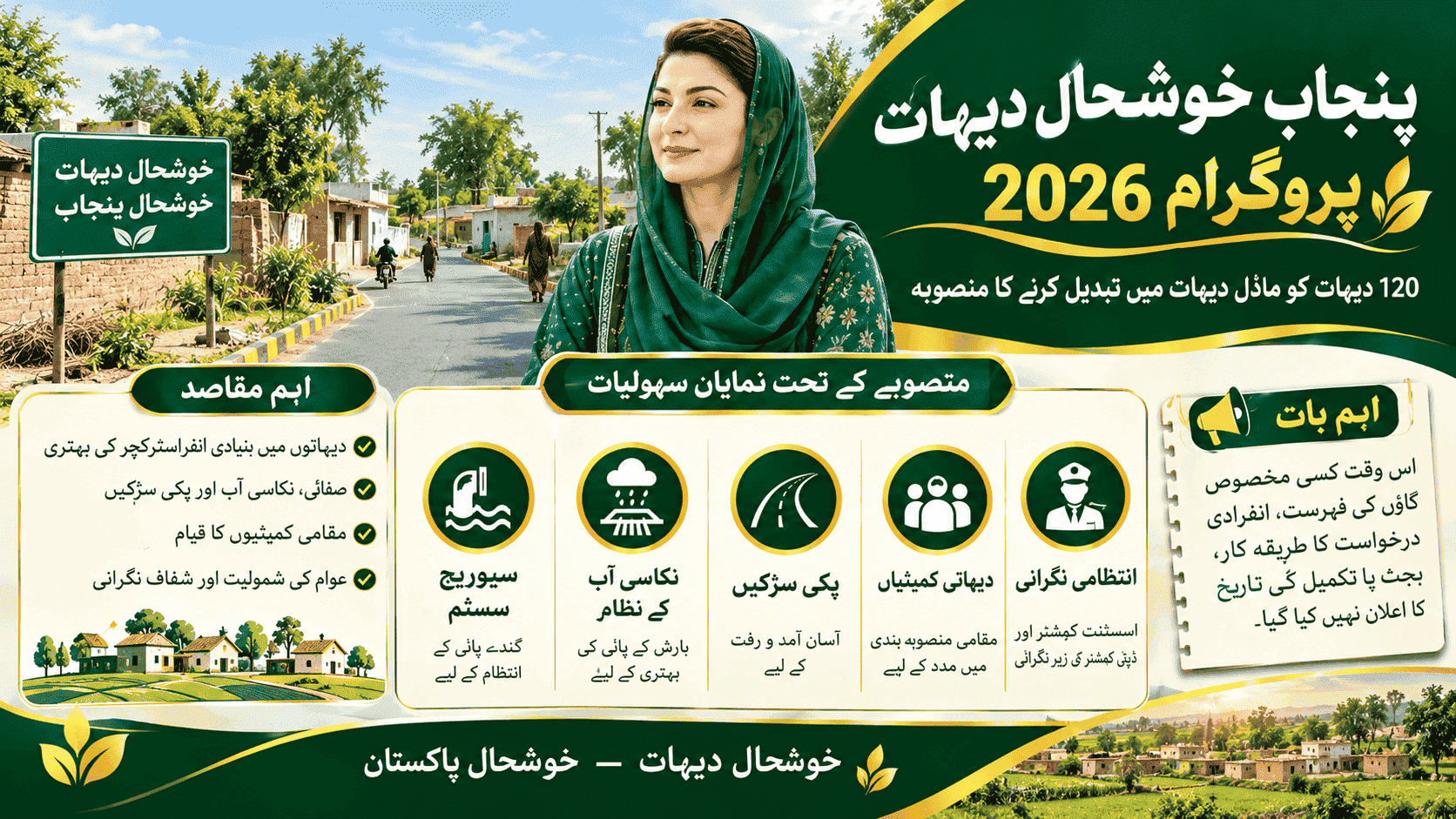
The Punjab Khushhal Dehat Program 2026 is a rural development initiative aimed at transforming 120 villages into model settlements through improved infrastructure and better living conditions. On October 20, 2026, Punjab Chief Minister Maryam Nawaz Sharif approved a pilot project for 120 villages and announced the government’s decision to introduce the Khushhal Dehat Act 2026. According to the reported briefing, the initiative will focus on sewerage systems, drainage facilities, and paved streets. The government also plans to establish village committees involving public representatives and government officials to support local development planning. Residents should note that the announcement does not yet provide a confirmed village list, individual application procedure, project budget, or completion schedule.
Punjab Khushhal Dehat Program 2026: Key Information
120 Model Villages — Key Information
| Program Detail | Latest Available Information |
|---|---|
| Program Name | Punjab Khushhal Dehat Program 2026 |
| Related Legislation | Proposed Khushhal Dehat Act 2026 |
| Province | Punjab, Pakistan |
| Chief Minister | Maryam Nawaz Sharif |
| Announcement Date | October 20, 2026 |
| Initial Project Scope | 120 villages |
| Project Type | Rural development pilot project |
| Main Infrastructure | Sewerage, drainage, and paved streets |
| Village Committees | Planned for each village in the pilot |
| Committee Leadership | Relevant Assistant Commissioner |
| Administrative Supervision | Deputy Commissioner |
| Public Participation | Local residents and public representatives will be consulted |
| Official Village List | Not provided in the cited announcement |
| Registration Portal | No dedicated portal confirmed |
| Individual Cash Assistance | Not announced |
| Project Budget | Not specified in the cited reports |
| Completion Deadline | Not specified in the cited reports |
Note: Information reflects the cited announcement available as of October 21, 2026. Details may change when the government releases further official instructions.
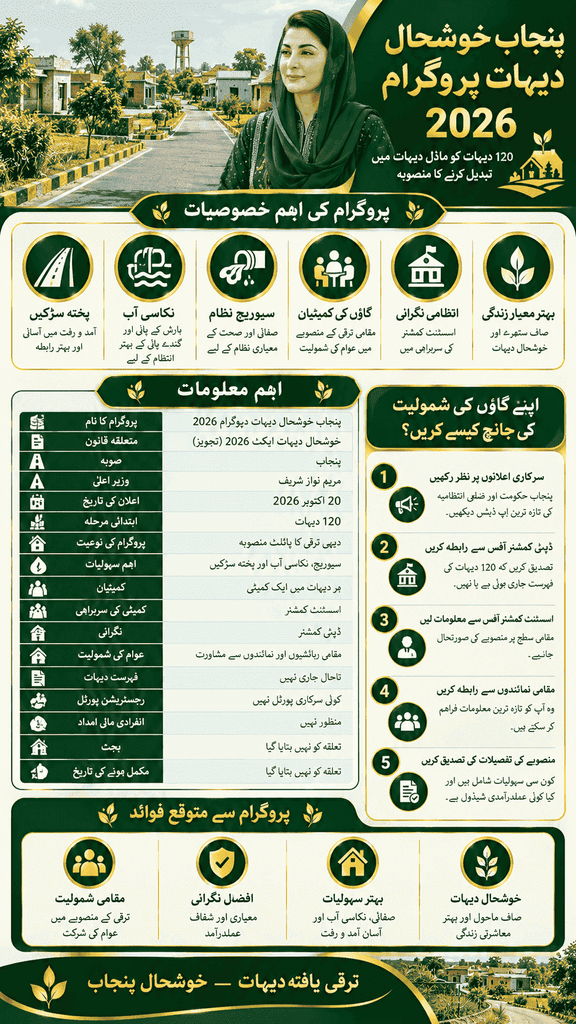
Information status: October 21, 2026. Details are based on the published announcement and may change when the government releases further instructions.
What Is the Punjab Khushhal Dehat Program 2026?
The Punjab Khushhal Dehat Program 2026 is a government initiative designed to improve basic infrastructure in rural areas. Its initial phase covers 120 villages that the government intends to develop as model settlements.
The announcement was made following a meeting chaired by Chief Minister Maryam Nawaz Sharif in Lahore on October 20, 2026. During the meeting, the government approved the pilot project and decided to introduce the Khushhal Dehat Act 2026.
The reported plan focuses on three main infrastructure improvements:
- Sewerage systems to support wastewater management.
- Drainage facilities to improve the handling of rainwater and wastewater.
- Paved streets to improve access within villages.
The government also directed the relevant authorities to establish village committees in consultation with local public representatives and prepare a comprehensive implementation plan.
The initiative reflects the government’s stated intention to extend development beyond major cities and improve conditions in rural communities.
Important distinction: Approval of the pilot project does not, by itself, establish that the proposed Act has been passed by the provincial assembly or formally enacted. The available reports describe a decision to introduce the Act.
Main Objectives of the Khushhal Dehat Act 2026
The proposed legislation is associated with the government’s broader rural development plans. The precise legal provisions of the Act have not been detailed in the cited announcement, so its objectives should be understood in the context of the announced pilot project.
1. Develop 120 Villages as Model Settlements
The initial project is intended to transform 120 villages into model settlements by improving their basic infrastructure.
The government has expressed a broader ambition to develop villages across Punjab. However, the current pilot covers 120 villages, and no confirmed timetable for extending this particular project to every village has been provided in the cited reports.
The pilot will be important in establishing how the development work is planned, coordinated, and supervised.
2. Improve Village Sewerage Systems
Sewerage is one of the three main infrastructure priorities identified in the project briefing.
Inadequate wastewater management can cause sewage to accumulate in residential areas, creating sanitation problems and making streets less suitable for everyday use.
Improved sewerage infrastructure could help address these problems. Its effectiveness will depend on the design of the system, the construction quality, and arrangements for ongoing maintenance.
The announcement does not specify the engineering designs, technical standards, or construction schedule for individual villages.
3. Upgrade Drainage Facilities
Drainage improvements are another stated component of the Khushhal Dehat initiative.
Effective drainage helps manage rainwater and wastewater and can reduce water accumulation in streets and residential areas. Appropriate drainage planning is particularly important where heavy rainfall or existing infrastructure problems affect village access.
The detailed drainage works for each selected village have not yet been specified in the cited announcement.
4. Construct Paved Streets
The reported project briefing also identifies paved streets as a planned improvement in the selected villages.
Paved streets can make movement easier for residents and vehicles and may improve access to homes and local services. Coordinating street construction with sewerage and drainage work will be important to avoid damaging newly completed roads during later infrastructure work.
The announcement does not provide a street-by-street construction plan or confirm the number of streets to be developed in each village.
5. Include Local Communities in Development Planning
The government has stated that local residents will be consulted during the planning and implementation of village development projects.
This approach can help authorities identify local infrastructure priorities and understand which problems residents consider most urgent.
Village committees are planned as part of this administrative structure. Their exact procedures, including how public representatives will be selected and how residents can submit complaints, require further official clarification.
How Will the 120 Model Villages Project Work?
According to the Associated Press of Pakistan, the government plans to establish a village committee in each village in consultation with local public representatives. The chief minister has directed the relevant authorities to constitute these committees and prepare a comprehensive plan. https://www.app.com.pk/punjab/cm-approves-pilot-project-to-develop-120-model-villages-in-punjab/
The reported structure includes local public representatives, government representatives, and district administration officials.
Village Committees
Each planned village committee will consist of eight members: four public representatives and four government representatives.
The reported briefing identifies the following government representatives or roles:
- The head teacher of a local school.
- The union council secretary.
- A doctor from a Basic Health Unit or Maryam Nawaz Health Clinic.
- Other relevant government representatives.
The committee is intended to provide a local structure for coordinating development initiatives.
The precise appointment procedure, meeting schedule, decision-making powers, and public complaint process have not been specified in the cited reports.
Role of the Assistant Commissioner
The relevant Assistant Commissioner will head the village committee.
This arrangement places local administrative leadership within the committee structure. The Assistant Commissioner is expected to help coordinate the work with the relevant authorities as the implementation plan is developed.
The specific operational responsibilities will depend on the final instructions issued by the government.
Role of the Deputy Commissioner
The Deputy Commissioner will supervise the village committees and oversee the project.
This district-level supervision is intended to provide administrative oversight of the initiative. The government has also emphasized quality and transparency in development projects.
The detailed monitoring procedures, reporting requirements, and performance indicators have not been published in the cited announcement.
Role of Public Representatives
The chief minister directed members of the provincial assembly and party ticket-holders to act as custodians of development projects in their respective villages.
The government has also stated that local residents will be consulted during development planning and implementation.
The precise division of responsibilities between public representatives, village committees, and district officials should be confirmed through subsequent official instructions.
What Facilities Are Planned Under the Khushhal Dehat Program?
The announcement identifies sewerage systems, drainage facilities, and paved streets as the main infrastructure components.
Planned Facilities and Their Purpose
Punjab Khushhal Dehat Program 2026
| Planned Facility | Purpose |
|---|---|
| Sewerage Systems | Improve wastewater management and support better sanitation. |
| Drainage Facilities | Help manage rainwater and wastewater in village areas. |
| Paved Streets | Improve movement and access within villages. |
| Village Committees | Support local consultation and development planning. |
| District-Level Supervision | Provide administrative oversight and project monitoring. |
Note: These are the planned facilities and administrative arrangements described in the reported announcement. Actual implementation details may be clarified in the official project plan.
These facilities are the infrastructure improvements identified in the reported briefing. The available announcement does not confirm additional facilities such as new schools, hospitals, water supply systems, electricity connections, housing grants, or direct cash payments under this initiative.
Residents should refer to the final implementation plan for the exact work approved in their village.
Who Can Benefit From the Punjab Khushhal Dehat Program 2026?
The project is focused on rural communities in the 120 villages covered by the pilot.
However, the cited announcement does not provide a verified list of selected villages or formal selection criteria. Consequently, residents cannot yet determine from the announcement alone whether their village is included.
The project is described as a community-level infrastructure initiative rather than an individual cash assistance or loan scheme.
Is There an Individual Eligibility Criteria?
No individual eligibility criteria have been published in the cited reports.
The announcement focuses on village development, infrastructure improvements, local committees, and administrative supervision. It does not describe an application-based benefit for individual households.
Residents should not assume that a household will receive money, construction assistance, or another personal benefit simply because it is located in a rural area.
Will Every Village in Punjab Be Included?
The approved pilot project covers 120 villages.
The chief minister has expressed the government’s ambition to transform villages across Punjab into model settlements. However, the broader ambition should not be interpreted as confirmation that every village is included in the initial phase.
The selected villages, district distribution, selection criteria, and schedule for any future expansion have not been confirmed in the cited reports.
How to Check Whether Your Village Is Included
Until an official village list is published, residents should use reliable government information to check the project’s status.
- Follow official announcements: Check updates from the Punjab government and relevant district administration.
- Contact the district administration: Ask the relevant Deputy Commissioner’s office whether an official list of the 120 selected villages is available.
- Consult local administration: The relevant Assistant Commissioner’s office may be able to clarify the project’s local status once implementation arrangements are issued.
- Ask local public representatives: They may be able to share verified information about village-level planning.
- Confirm the scope of work: If your village is included, ask which infrastructure improvements have been approved and whether an implementation schedule has been issued.
These are suggested ways to seek information, not an officially announced registration procedure.
Is There an Official Khushhal Dehat Registration Portal?
As of October 21, 2026, the cited reports do not identify a dedicated online registration portal for the Punjab Khushhal Dehat Program 2026.
The announcement concerns the approval of the 120-village pilot project, the planned establishment of village committees, and preparation of a comprehensive implementation plan.
No official application link, individual registration form, application fee, or dedicated helpline is confirmed in the cited announcement.
Residents should therefore avoid submitting personal information through unverified websites or paying agents who claim to guarantee inclusion in the project.
If the government later introduces an official portal or a formal public participation process, residents should verify the details through a reliable government announcement before using it.
Does the Khushhal Dehat Program Offer Cash Payments or Loans?
The available announcement does not mention individual cash payments, personal loans, household grants, or a financial assistance package under the Khushhal Dehat initiative.
Its stated priorities are community-level infrastructure and village development.
Khushhal Dehat Program 2026: Benefits and Registration Status
Important Information for Punjab Residents
| Question | Information Confirmed |
|---|---|
| Does it offer direct cash payments? | Not announced |
| Does it provide personal loans? | Not announced |
| Is household registration open? | No procedure confirmed |
| Does it include infrastructure development? | Yes |
| Does it cover a pilot of 120 villages? | Yes |
| Is a dedicated application portal available? | Not confirmed |
Important note: The reported announcement focuses on village-level infrastructure. No individual cash assistance, personal loan facility, or household registration procedure has been confirmed in the cited information.
People seeking financial assistance should consult the separate eligibility and application rules of the relevant welfare or loan program. They should not assume that benefits from another government scheme are included in Khushhal Dehat.
Expected Benefits of the 120 Model Villages Project
The announced infrastructure improvements could provide practical benefits to participating communities if they are implemented effectively.
Improved Sanitation
Better sewerage infrastructure could help communities manage wastewater and reduce sanitation problems associated with inadequate facilities.
The actual results will depend on the quality and capacity of the systems installed and how they are maintained after construction.
Better Village Access
Paved streets could improve access within residential areas and make everyday journeys more convenient.
The benefits will depend on the locations selected for construction and how the work is coordinated with drainage and sewerage improvements.
Greater Local Participation
Village committees and consultation with residents could provide a more organized way to identify infrastructure needs.
The effectiveness of this approach will depend on how the committees operate and how residents’ concerns are considered during planning.
Improved Project Oversight
The proposed structure assigns leadership to the Assistant Commissioner and supervision to the Deputy Commissioner.
Clear responsibilities and effective monitoring could help authorities coordinate work and identify implementation problems.
These are potential benefits of the announced approach, not guarantees that particular results have already been achieved.
Challenges That Could Affect Implementation
The success of the project will depend on how the government moves from approval and planning to actual construction and long-term maintenance.
Village Selection and Transparency
A publicly available list of selected villages would help residents understand where the pilot will operate.
The criteria used to select villages have not been specified in the cited reports. Clear communication about selection and project scope will therefore be important.
Funding and Budget Allocation
The cited announcement does not provide a total project budget or village-level allocations.
The funding arrangements will be important in determining the scope, pace, and quality of the infrastructure improvements.
Construction Standards
Sewerage systems, drainage facilities, and paved streets need to be designed for local conditions.
Poor construction or inadequate coordination between infrastructure projects can reduce the usefulness of the completed work.
Maintenance After Construction
Infrastructure needs ongoing maintenance to remain functional.
The government will need to clarify the relevant maintenance responsibilities and arrangements as implementation details become available.
Public Accountability
Residents need reliable ways to receive updates and raise concerns about local development work.
The announcement emphasizes quality and transparency, but the specific complaint channels and monitoring procedures have not yet been detailed in the cited reports.
Latest Update on Punjab Khushhal Dehat Program 2026
The latest confirmed announcement covered here was made on October 20, 2026.
According to Radio Pakistan and the Associated Press of Pakistan, the key decisions and directions were:
- Approval of a pilot project covering 120 villages.
- A decision to introduce the Khushhal Dehat Act 2026.
- Plans to establish a village committee in each village.
- Direction to the relevant authorities to prepare a comprehensive implementation plan.
- Appointment of the relevant Assistant Commissioner as committee head.
- Supervision of the committees and project by the Deputy Commissioner.
- Planned sewerage, drainage, and paved street improvements.
- Consultation with local residents during development planning.
Details still awaiting official confirmation: the list of selected villages, project budget, selection criteria, construction start dates, completion deadline, and any public registration procedure.
The proposed Act’s formal legislative status should also be checked against subsequent official government or provincial assembly records before describing it as enacted law.
Frequently Asked Questions (FAQs)
1. What is the Punjab Khushhal Dehat Program 2026?
It is a rural development initiative intended to transform 120 villages into model settlements through improvements to sewerage systems, drainage facilities, and paved streets.
2. Who approved the 120 Model Villages Project?
Punjab Chief Minister Maryam Nawaz Sharif approved the pilot project during a meeting on October 20, 2026, according to published reports.
3. Has the Khushhal Dehat Act 2026 become law?
The cited reports say that the government decided to introduce the Act. They do not establish that it has been formally enacted into law.
4. How can I apply for the Khushhal Dehat Program?
No individual application process or dedicated registration portal has been confirmed in the cited announcement. Residents should follow official government updates for further instructions.
5. Which villages are included in the first phase?
The pilot project covers 120 villages, but the cited announcement does not provide a verified public list of the selected villages.
6. What facilities will be provided under the program?
The reported infrastructure priorities are sewerage systems, drainage facilities, and paved streets. Additional facilities should not be assumed unless they are confirmed by the government.
7. Will the government provide cash assistance under Khushhal Dehat?
No individual cash payment or personal financial assistance package was announced in the cited reports. The initiative focuses on village-level infrastructure development.
8. Who will supervise the village committees?
The relevant Assistant Commissioner will head each village committee, while the Deputy Commissioner will supervise the committees and oversee the project.
9. Is the program available throughout Punjab?
The pilot project covers 120 villages. Although the chief minister has expressed a broader ambition to develop villages across Punjab, the first-phase village list and any expansion schedule have not been confirmed in the cited reports.
Conclusion
The Punjab Khushhal Dehat Program 2026 is a rural development initiative centered on an approved pilot project for 120 villages. The government has identified sewerage systems, drainage facilities, and paved streets as its main infrastructure priorities and has directed authorities to establish village committees and prepare a comprehensive implementation plan.
The initiative could improve rural living conditions if the work is properly planned, funded, constructed, and maintained. Its practical impact will depend on the final village selection, implementation arrangements, construction quality, and transparency in project oversight.
For residents, the most important next step is to follow verified government announcements for the selected-village list and further implementation details. No dedicated registration portal, individual cash assistance package, or application fee has been confirmed in the reports cited here.
Disclaimer: Sardar Article is an independent information website and is not affiliated with the Punjab government. This article summarizes publicly reported information and should not be treated as an official government notification. Readers should verify new announcements through official sources before acting on program-related information.



Leave a Reply