

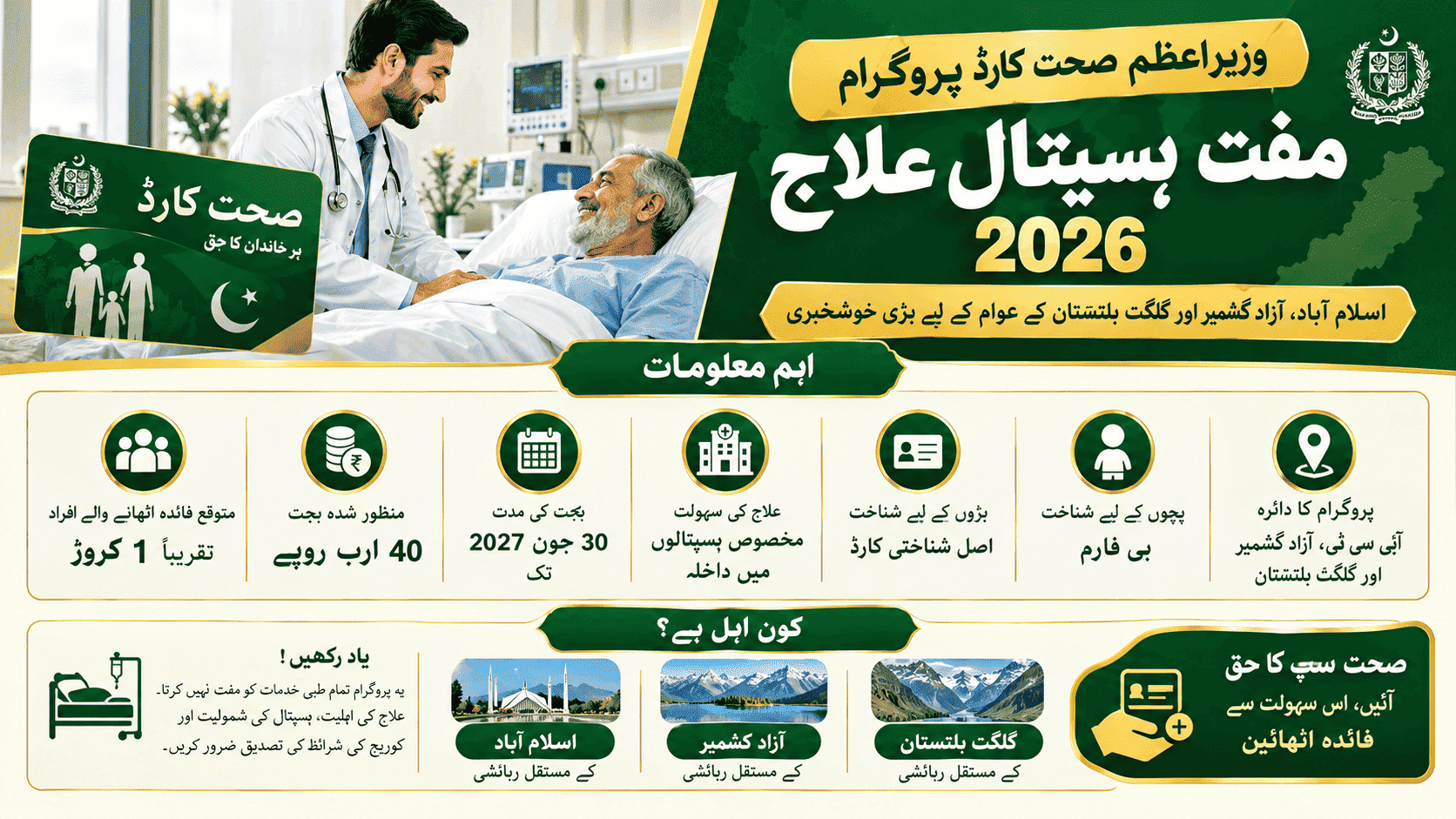
The Government of Pakistan has restored the Prime Minister’s Health Card programme to provide free, cashless hospitalization services to eligible permanent resident families in Islamabad Capital Territory (ICT), Azad Jammu and Kashmir (AJK), and Gilgit-Baltistan (GB). The programme was formally launched on January 16, 2026, to help residents access approved hospital treatment without bearing the full cost of covered services themselves.
According to official announcements, the initiative is expected to benefit approximately 10 million people. The government has approved an estimated budget of Rs. 40 billion for the programme through June 30, 2027. Eligible residents can use their CNIC or, for children, their B-Form to seek treatment at designated hospitals, where facilitation desks provide guidance on accessing services.
For families facing expensive medical treatment, this programme can offer important financial relief. However, residents should understand the eligibility requirements, the difference between hospitalization and outpatient care, and the steps required to receive treatment before visiting a hospital.
Free Hospital Treatment 2026 – Key Information
| Key Information | Details |
|---|---|
| Programme Name | Prime Minister’s Health Card / Federal Sehat Sahulat Programme |
| Programme Year | 2026 |
| Main Purpose | Cashless coverage for approved hospitalization services |
| Eligible Regions | Islamabad Capital Territory, Azad Jammu and Kashmir (AJK), and Gilgit-Baltistan (GB) |
| Eligibility Basis | Permanent address in a covered region recorded on the CNIC, subject to official verification |
| Expected Beneficiaries | Approximately 10 million people |
| Approved Programme Budget | Approximately Rs. 40 billion |
| Funding Period | Through June 30, 2027 |
| Adult Identification | Original CNIC |
| Child Identification | B-Form |
| Treatment Facilities | Designated participating government and private hospitals |
| Registration Process | Verify eligibility and follow the hospital admission procedure |
| Treatment Type | Hospitalization services under the programme’s approved rules |
| Official Announcement | Read Official Announcement – Radio Pakistan |
What Is the Prime Minister’s Health Card Programme?
The Prime Minister’s Health Card programme operates through the federal Sehat Sahulat health coverage framework. Its purpose is to help eligible families access approved hospital treatment without paying the full covered cost out of pocket.
The federal government restored the programme for Islamabad, AJK, and Gilgit-Baltistan after reviewing the continuation of universal health coverage services. The initiative is designed around a health coverage model in which participating hospitals provide eligible services according to the programme’s rules.
The National Steering Committee of the Sehat Sahulat Programme reviewed the restoration arrangements on January 12, 2026. The programme was subsequently launched on January 16, 2026.
The government approved an estimated programme cost of approximately Rs. 40 billion through June 30, 2027, to support hospitalization services for eligible permanent resident families in the three covered regions.
Official announcements:
- National Steering Committee announcement — Press Information Department
- Prime Minister’s Health Card launch — Radio Pakistan
Who Is Eligible for Free Hospital Treatment in 2026?
According to the official launch announcement, people whose permanent address is recorded on their CNIC in Islamabad, AJK, or Gilgit-Baltistan are eligible under the programme, subject to the applicable verification and admission requirements.
1. Islamabad Residents
Permanent residents of Islamabad Capital Territory may qualify if their CNIC records the required address and their eligibility is confirmed through the programme’s verification process.
2. Azad Jammu and Kashmir Residents
Permanent resident families of AJK are included in the restored health coverage initiative. Applicants should carry their original CNIC and ensure that their identity information is accurate.
3. Gilgit-Baltistan Residents
Residents of Gilgit-Baltistan whose permanent addresses are recorded in the covered region may also access eligible hospitalization services under the programme.
4. Children and Dependent Family Members
Children can use their B-Form as identification when seeking eligible treatment. Parents or guardians should carry any additional family or medical documents requested by the hospital.
Does the Programme Require a Low-Income Status?
The official January 2026 launch announcement describes eligibility in terms of permanent residence in the covered regions rather than stating a specific household income threshold. Therefore, applicants should not assume that a particular income or poverty score is required unless the programme’s current rules specify one.
The final decision regarding an individual patient’s eligibility and admission should be confirmed through the programme’s verification process or a participating hospital.
Which Medical Services Are Covered?
The programme’s current announced scope focuses on hospitalization services. The exact treatment package and financial limits applicable to a particular patient should be confirmed with the participating hospital.
Depending on the approved package, covered services may include eligible inpatient medical treatment, approved surgical procedures, and other hospital services associated with an authorized admission.
However, the programme should not be interpreted as providing unlimited free healthcare.
Hospitalization Services
Patients who require hospital admission may qualify for treatment if their medical condition and proposed services meet the programme’s requirements.
Approved Surgical Procedures
Some surgical procedures may be covered when they fall within the approved treatment package and the hospital completes the necessary authorization process.
Diagnostic Services During Admission
Tests and investigations associated with an approved hospitalization may be covered according to the applicable package. Patients should confirm coverage with the hospital before undergoing additional procedures.
Outpatient Department Services
The January 2026 launch announcement stated that hospitalization services were being offered at that time, while outpatient department (OPD) and other healthcare services were being considered for future inclusion.
Therefore, routine OPD consultations should not be advertised as covered under the programme without an updated official confirmation.
Medicines and Other Expenses
Coverage for medicines, follow-up treatment, diagnostic tests, and services outside the hospital admission must be confirmed individually. Ask the hospital whether any proposed service falls outside the approved package.
How to Get Free Hospital Treatment in 2026
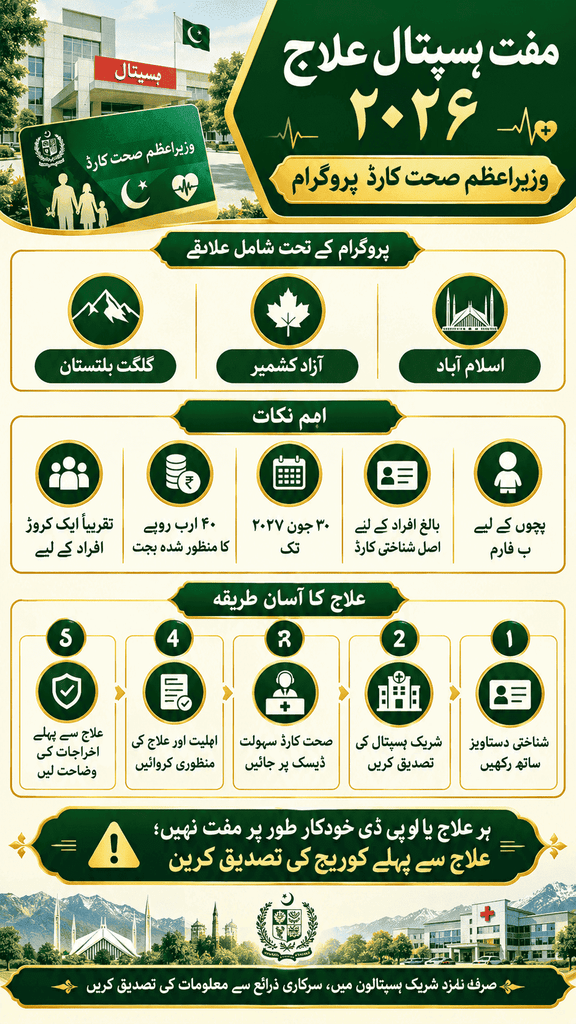
Eligible residents can follow these steps to seek treatment under the Prime Minister’s Health Card programme.
Step 1: Prepare Your CNIC or B-Form
Adults should carry their original CNIC. For children, take the B-Form and any additional identification documents requested by the hospital.
Make sure the permanent address recorded on the CNIC corresponds to one of the covered regions.
Step 2: Identify a Participating Hospital
Choose a designated government or private hospital that participates in the programme. The hospital must also provide the medical specialty or treatment required by the patient.
Do not assume that every hospital participates simply because it is located in Islamabad, AJK, or Gilgit-Baltistan.
Step 3: Visit the Hospital’s Facilitation Desk
When you arrive, ask for the Health Card or Sehat Sahulat Programme facilitation desk.
Explain that you want to receive treatment under the Prime Minister’s Health Card programme. Hospital staff can guide you through the identity verification and admission process.
Step 4: Complete Eligibility Verification
Present your original identity documents and provide the information required for verification. The hospital will guide you on whether the patient meets the programme’s applicable requirements.
If the records do not match, ask the facilitation desk how to correct or resolve the discrepancy through the appropriate official channel.
Step 5: Undergo Medical Assessment
The hospital’s medical team will assess the patient and determine the appropriate treatment.
The proposed admission and services must meet the programme’s coverage and authorization rules. Eligibility alone does not guarantee that every requested procedure will be approved.
Step 6: Confirm Coverage Before Treatment
Before admission or a procedure, ask hospital staff to explain which services are covered and whether any proposed treatment falls outside the approved package.
The programme has been described as cashless for covered services. Patients should not assume they must pay first and claim reimbursement later.
Step 7: Keep Your Medical Documents
Retain prescriptions, diagnostic reports, discharge summaries, and any paperwork provided by the hospital. These documents can help with follow-up treatment and resolving questions about coverage.
Which Hospitals Accept the Health Card?
The Prime Minister’s Health Card programme operates through designated participating government and private hospitals.
The government announced that additional hospitals were being included to improve access for residents of Islamabad, AJK, and Gilgit-Baltistan. However, participation can vary by facility, and not every hospital or specialty is necessarily available under the programme.
Before travelling, confirm the following with the hospital:
- Whether it currently participates in the Prime Minister’s Health Card programme.
- Whether it offers the required medical specialty.
- Whether the proposed treatment falls within the approved coverage package.
- Whether any referral or prior authorization is necessary.
- Whether the hospital is currently accepting eligible patients under the programme.
For current information, consult the official Ministry of Information and Broadcasting website and the National Health Services Ministry and programme announcements.
If the hospital cannot confirm participation, contact the relevant programme office through an official government channel before arranging admission.
Major Benefits of Free Hospital Treatment for Families
1. Reduced Financial Pressure
Hospital treatment can place significant pressure on household finances. Cashless coverage for approved services can reduce the amount eligible patients need to pay directly.
2. Access to Participating Private and Government Hospitals
The programme includes designated facilities in both sectors, giving eligible residents access to participating hospitals according to the programme’s arrangements.
3. Support for Eligible Inpatient Treatment
Patients who need an approved hospital admission may receive covered services without paying the full covered amount themselves.
4. Protection Against Unexpected Medical Bills
Serious illnesses and surgical procedures can lead to substantial expenses. Health coverage can help eligible families manage the financial impact of hospitalization.
5. Coverage Across Three Regions
The restored initiative provides a common federal health coverage framework for eligible permanent residents of Islamabad, AJK, and Gilgit-Baltistan.
6. A Defined Programme Period
The approved funding framework extends through June 30, 2027. This gives the programme a stated funding period, although individual treatment availability should always be verified.
Is Online Registration Required?
The official launch announcement explains that eligible patients can use their CNIC or a child’s B-Form at designated hospitals, where facilitation desks guide them through the process.
It does not establish that every family must complete a separate online registration form before receiving treatment. Therefore, applicants should not rely on unofficial websites claiming that a new online application is compulsory.
The practical approach is to:
- Check that your permanent address is recorded correctly on your CNIC.
- Contact or visit a participating hospital.
- Present the required identity documents.
- Ask the facilitation desk to verify your eligibility.
- Follow the hospital’s admission and authorization procedure.
If the hospital reports a problem with your record, request guidance on the appropriate official correction or verification process.
Is There a Health Card Helpline or Official Registration Portal?
The official announcements cited in this guide provide programme information and explain the hospital-based facilitation process. They do not, by themselves, establish a single current helpline number or a dedicated online registration portal for every eligible resident.
For that reason, this article does not publish an unverified phone number or application link.
Residents should use the official government sources below and ask a participating hospital for the relevant programme contact details.
- Prime Minister’s Health Card launch announcement
- National Steering Committee announcement
- Ministry of Information and Broadcasting
Avoid sharing your CNIC details, photographs of identity documents, or other sensitive information with unknown websites or social media accounts.
Important Instructions Before Visiting a Hospital
Keep the following precautions in mind to avoid unnecessary delays.
- Check your identity records: Your CNIC should contain the correct permanent address.
- Carry original documents: Take your CNIC or the child’s B-Form, as applicable.
- Confirm hospital participation: Verify that the hospital accepts eligible patients under the programme.
- Ask about the treatment package: Confirm whether your condition and proposed procedure are covered.
- Understand cashless treatment: Ask the hospital to explain any service that may fall outside the approved package.
- Keep medical records: Bring relevant reports and prescriptions.
- Avoid unofficial agents: Do not pay anyone who promises guaranteed eligibility or admission.
- Verify changing rules: Hospital networks and programme procedures may change, so obtain current information before travelling.
Frequently Asked Questions (FAQs)
1. Who is eligible for Free Hospital Treatment 2026?
People whose permanent address is recorded on their CNIC in Islamabad Capital Territory, AJK, or Gilgit-Baltistan are included under the announced eligibility framework, subject to official verification and the programme’s admission rules.
2. What documents are required to receive treatment?
Adults should carry their original CNIC. Children can use their B-Form. The hospital may also request relevant medical reports or additional documents.
3. Is the Prime Minister’s Health Card programme free?
The programme provides cashless treatment for services covered under its approved rules. It does not mean that every medical service or expense is automatically free.
4. Can I receive treatment at any private hospital?
No. You should confirm that the private hospital participates in the programme and provides the required treatment under its approved arrangements.
5. Does the programme cover OPD consultations?
The January 2026 launch announcement described hospitalization as the service available at that time. OPD services should not be assumed to be covered without an updated official announcement.
6. Is online registration compulsory?
The announced process allows eligible residents to present their identity documents at designated hospitals and receive guidance from facilitation desks. Confirm any additional registration requirements with the programme or hospital.
7. How much funding has been approved?
The National Steering Committee approved an estimated programme cost of approximately Rs. 40 billion through June 30, 2027.
8. Is a separate health card required?
The launch announcement identifies the CNIC, or the B-Form for children, as identification for accessing treatment at designated hospitals. Confirm any additional requirements with the hospital.
9. What should I do if the hospital cannot verify my eligibility?
Ask the hospital’s facilitation desk to explain the problem and direct you to the appropriate official verification or record-correction process.
10. Where can I find official information?
You can read the Radio Pakistan announcement and the Press Information Department announcement for details about the programme’s restoration, intended beneficiaries, and approved funding period.
Conclusion
The Free Hospital Treatment 2026 initiative offers important potential relief for eligible permanent resident families in Islamabad, Azad Jammu and Kashmir, and Gilgit-Baltistan. Through the restored Prime Minister’s Health Card programme, eligible patients can seek cashless hospitalization services at designated participating hospitals.
The government has announced an estimated budget of Rs. 40 billion through June 30, 2027, with the initiative expected to benefit approximately 10 million people. However, the exact services available to an individual patient depend on the programme’s current coverage rules and hospital admission procedures.
Before seeking treatment, check your CNIC details, carry the required documents, and confirm the hospital’s participation and the treatment package. Use official government sources and hospital facilitation desks rather than relying on unverified registration links or agents.

Leave a Reply