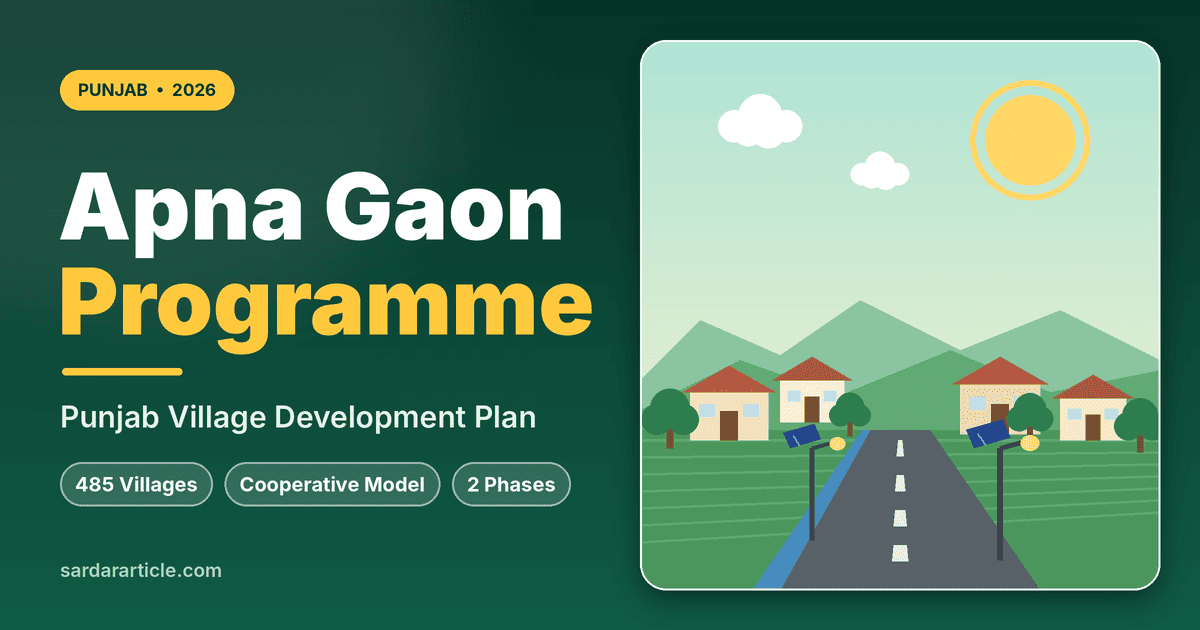
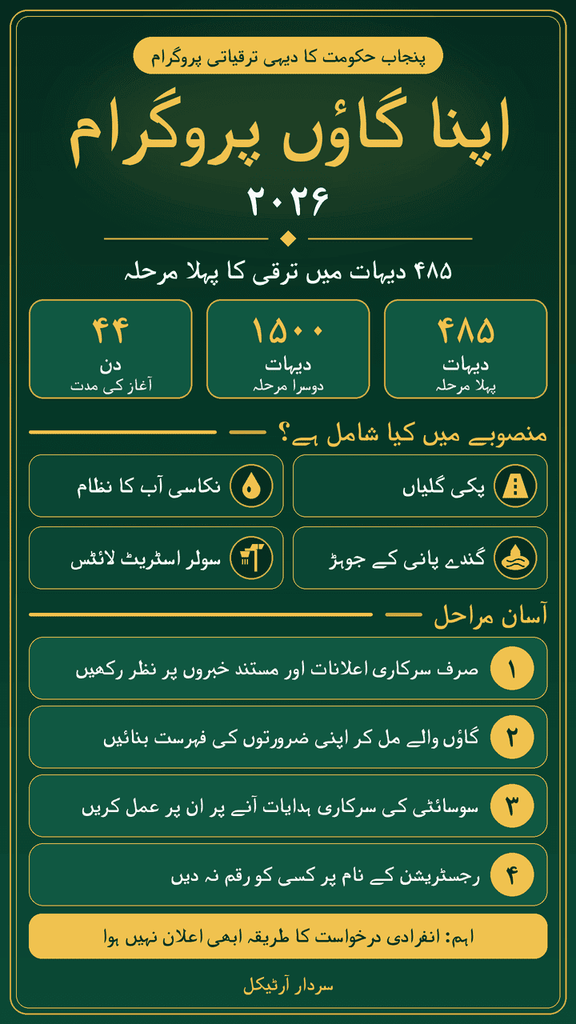
Punjab Chief Minister Maryam Nawaz Sharif has approved the CM Punjab Apna Gaon Programme, a rural development plan in which villagers will help decide and carry out projects in their own villages through registered cooperative societies. The announcement came on 17 November 2026 at a meeting in Lahore. It covers basic infrastructure that rural communities often lack: paved streets, drainage, wastewater disposal ponds and solar-powered streetlights.
The programme is not a cash-assistance scheme or a loan, so there is no application form for individuals. It is a community-led development model, with 485 villages in the first phase and another 1,500 in the second. The Punjab government has also partially lifted a ban on cooperative societies that had been in place for 29 years. This article covers what has been announced, how the cooperative model works, and what has not yet been clarified.
Apna Gaon Programme 2026 at a Glance
| Detail | Information |
|---|---|
| Programme name | CM Punjab Apna Gaon Programme |
| Announced by | Chief Minister Maryam Nawaz Sharif |
| Announcement date | 17 November 2026 (meeting in Lahore) |
| Type | Community-led rural development programme |
| Delivery model | Village cooperative societies |
| Phase 1 | Cooperative societies in 485 villages |
| Phase 2 | Another 1,500 villages |
| Total planned coverage | 1,985 villages |
| Planned facilities | Paved streets, drainage systems, wastewater disposal ponds, solar streetlights |
| Society management | Five-member committee (president, vice president, general secretary, treasurer, executive member) |
| Monitoring | Five-member tehsil committee headed by the Assistant Commissioner |
| Launch deadline | 44 days from the announcement |
| Budget | Not announced in the reports reviewed |
| Individual application | No public application process announced |
| Category | Punjab government development programme |
What Is the Apna Gaon Programme?
“Apna Gaon” means “Our Village.” The idea is that people who live in a village know best which problems need fixing first, so they should have a direct say in setting priorities. The government plans to work through cooperative societies, giving villagers an organised, accountable structure for planning and overseeing local projects.
One outlet, Dunya News, reported the same initiative under the name “Khushhal Dehat Programme.” Most other reports use “Apna Gaon Programme,” and the CM Punjab version of the name appears in official-style coverage.
Key Features of the Programme
Basic Infrastructure for Villages
The planned works address common rural problems:
- Paved streets: Better access in villages where lanes become muddy or damaged, especially in the rainy season.
- Drainage systems: Proper channels for rainwater and household water, to reduce standing water.
- Wastewater disposal ponds: Designated ponds so that dirty water is collected in one place rather than flowing through lanes.
- Solar streetlights: The Chief Minister directed that villages get solar-powered lights, which do not depend on grid electricity.
Villagers Choose the Projects
The core feature is who decides. Through their cooperative society, residents will be able to decide which development projects their village needs most. The Chief Minister said the government wants to make development “sustainable and effective” by giving responsibility to local communities.
Two-Phase Rollout
| Phase | Villages | Note |
|---|---|---|
| Phase 1 | 485 | Cooperative societies set up first |
| Phase 2 | 1,500 | Planned expansion after the first phase |
| Total | 1,985 | Planned overall coverage |
How the Cooperative Society Model Works
What Is a Cooperative Society?
A cooperative society is a registered group of people who join together voluntarily to pursue a shared goal and manage it collectively. Under the Apna Gaon model, residents of a village form a society that plans and carries out local development work.
Structure of Each Society
Each society will have a five-member management committee:
- President
- Vice president
- General secretary
- Treasurer
- Executive member
Oversight and Monitoring
To keep the process transparent, a separate five-member tehsil monitoring committee will supervise the societies. It will be headed by the Assistant Commissioner and will include the Assistant Director of Local Government.
Why the Lifted Ban Matters
Reports say Punjab had restricted the formation of cooperative societies for 29 years. The government has now agreed to partially lift that ban to make this programme possible. This is a notable policy change, as it reopens a model that had been largely closed to new societies for nearly three decades. The word “partially” matters: the reports do not say which categories remain restricted.
Timeline and Launch Deadline
The Chief Minister set a 44-day deadline to launch the programme. Counting from the 17 November announcement, that points to roughly the end of December 2026. The reports do not state an exact launch date, so treat this as an estimate until the Punjab government publishes one.
Who Will Benefit?
The direct beneficiaries are residents of villages selected for the two phases. Since the works are shared infrastructure, such as streets, drainage and lighting, the benefit goes to the whole village community rather than to individuals. The list of the 485 first-phase villages had not been published in the reports reviewed.
Is There an Application Process?
No public application process, registration portal or eligibility form has been announced. This is different from schemes such as loans or financial assistance. Villagers will most likely take part by forming and joining their village society once the programme formally starts, but the exact steps are yet to be announced.
Be cautious of anyone claiming to “register” you for the programme in exchange for money. Rely only on announcements from the Punjab government and its departments.
What Is Still Not Clear
Several practical details were missing from the reports available at the time of writing:
- Budget: The total amount, and how funds will be released, was not stated.
- Village selection: The criteria and the list of the 485 villages were not published.
- Funding responsibility: Whether costs are fully government-funded or involve community contribution was not stated.
- Which restrictions stay: The scope of the “partial” lifting of the cooperative ban was not detailed.
- Exact launch date: Only the 44-day deadline was given.
Check for official updates before relying on any of these points.
How This Fits Punjab’s Wider Development Push
The programme adds to other recent efforts by the provincial government. If you are following development across the province, our coverage of development projects in Attock shows how district-level packages are being announced. For rural livelihoods, see our guide on farm mechanization, and for more programmes, browse the latest Punjab government schemes.
Frequently Asked Questions (FAQs)
What is the Apna Gaon Programme?
It is a Punjab rural development programme approved by Chief Minister Maryam Nawaz Sharif. Villages will get paved streets, drainage, wastewater ponds and solar streetlights, with projects carried out through village cooperative societies.
How many villages are included?
The first phase covers 485 villages, and the second phase adds 1,500, for 1,985 planned villages in total.
Is Apna Gaon a financial assistance scheme?
No. It is an infrastructure programme for villages, and individuals do not receive cash or loans from it.
Can I apply online?
No online application or registration has been announced.
Who will manage the projects?
Each village cooperative society will have a five-member management committee. A five-member tehsil committee, headed by the Assistant Commissioner, will monitor the societies.
When will the programme start?
The Chief Minister set a 44-day deadline for launch. The exact date has not been published, but it points to around the end of December 2026.
What does the lifted cooperative ban mean?
Punjab has partially lifted a 29-year-old ban on cooperative societies so that villages can form societies under this programme.
Which villages will be selected first?
The list of the first 485 villages had not been published in the reports reviewed.
Conclusion
The Apna Gaon Programme is a notable shift in how rural development is planned in Punjab. Instead of projects being decided entirely from the top, villagers get an organised role through cooperative societies, supported by monitoring at the tehsil level. With 1,985 villages planned across two phases, and a partial lifting of a 29-year ban to make it possible, the programme could reach a large number of rural communities.
Key details such as the budget, village list and exact launch date are still to come. Follow official Punjab government announcements for confirmed updates.