
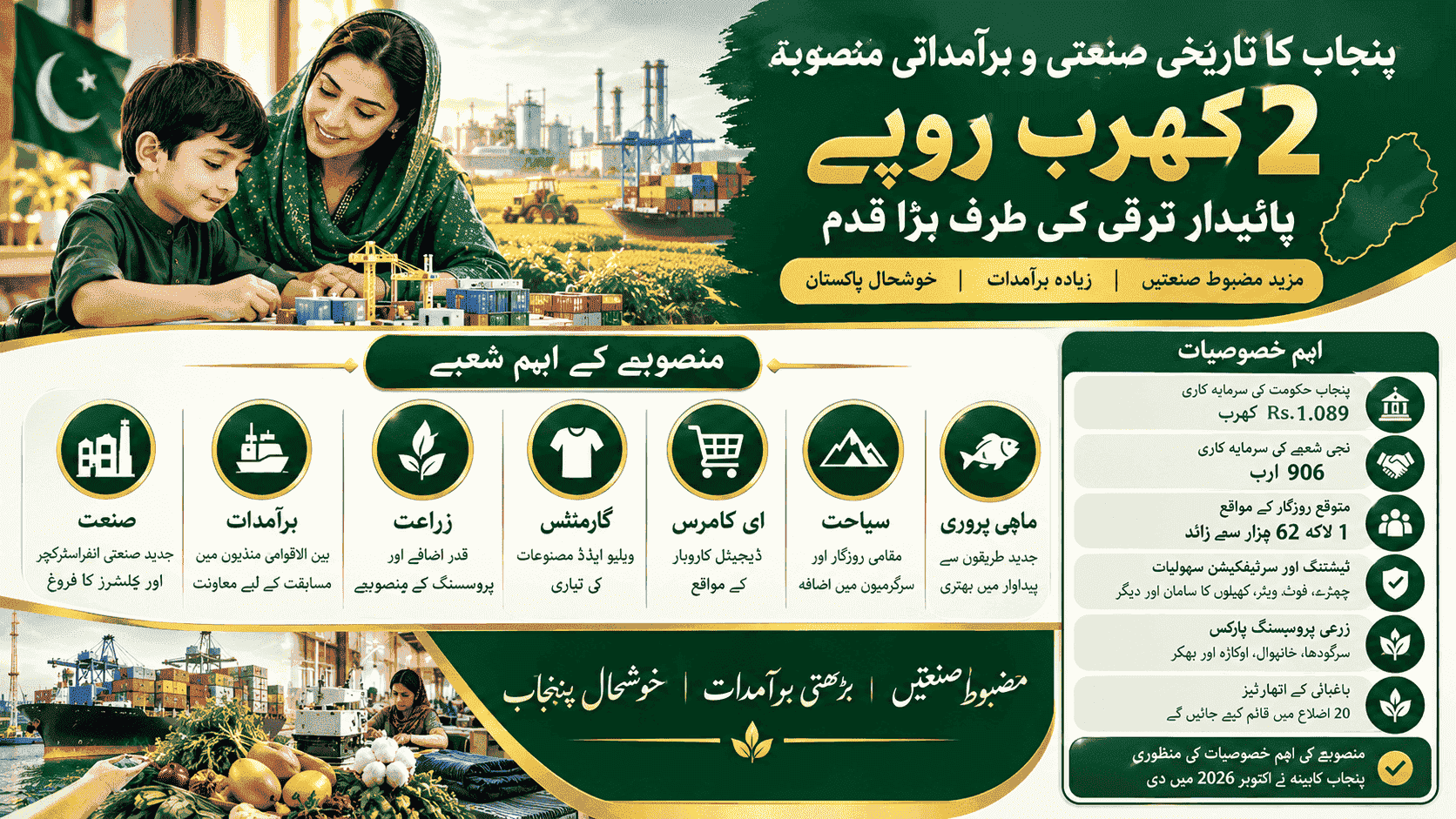
Pakistan’s industrial and export landscape is set for another major development in 2026 following the Punjab government’s approval of a new Rs. 1.995 trillion industrial development and export promotion programme. The initiative, commonly described in media reports as a Rs. 2 trillion plan, is designed to strengthen industrial infrastructure, improve export competitiveness, encourage private investment, increase value addition and create new employment opportunities.
A key clarification is important for readers: the Rs. 1.995 trillion programme is a Punjab government initiative, not a single nationwide federal cash or investment scheme. According to the cabinet briefing, the programme is expected to involve Rs. 1.089 trillion from the provincial government and Rs. 906 billion from the private sector, with more than 162,000 jobs expected to be created.
The programme, reported as PIVOT — Punjab Innovative for Value, Opportunity and Transformation, covers industrial infrastructure, cluster development, export competitiveness, value-chain transformation, agricultural and livestock mechanisation, e-business, e-commerce, garments, testing and certification, agricultural processing, skills development and public-private partnerships.
Rs. 2 Trillion Industrial & Export Plan 2026 at a Glance
| Key Detail | Information |
|---|---|
| Programme Value | Rs. 1.995 trillion |
| Common Description | Rs. 2 trillion industrial and export plan |
| Programme Scope | Punjab |
| Programme Name | PIVOT — Punjab Innovative for Value, Opportunity and Transformation |
| Provincial Government Investment | Rs. 1.089 trillion |
| Expected Private-Sector Investment | Rs. 906 billion |
| Expected Employment Impact | More than 162,000 jobs |
| Main Objective | Industrial development and export promotion |
| Key Sectors | Industry, exports, agriculture, e-commerce, garments, tourism and aquaculture |
| Testing & Certification | Leather, footwear, sports goods, cutlery, handmade tools, ceramics and fans |
| Agricultural Processing Parks | Sargodha, Khanewal, Okara and Bhakkar |
| Horticulture Authorities | Planned in 20 districts |
| Status | Key features approved by Punjab Cabinet in October 2026 |
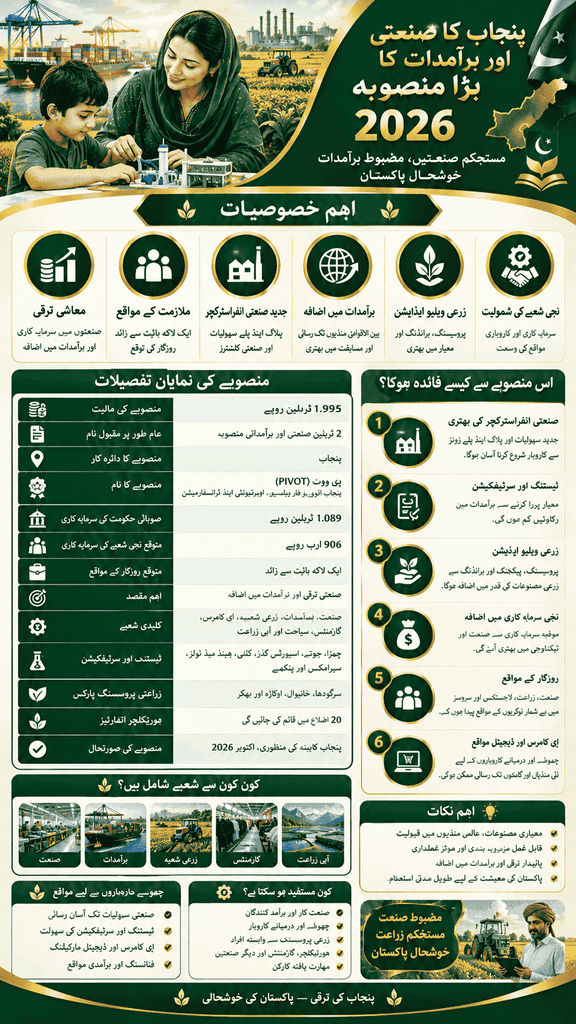
The figures represent the programme as reported following the Punjab Cabinet’s October 2026 approval. They should not be interpreted as a nationwide federal allocation or as money being distributed directly to citizens.
What Is the Rs. 2 Trillion Export and Industrial Expansion Plan?
The Rs. 1.995 trillion programme is a broad industrial and export development initiative approved by the Punjab Cabinet. Its objective is to strengthen the economic ecosystem around manufacturing, agriculture, exports and private investment.
The programme focuses on several interconnected areas rather than a single industry. These include industrial infrastructure, industrial clusters, export competitiveness, value addition, agricultural mechanisation, livestock, e-commerce, garments, testing facilities and public-private partnerships.
This approach is important because increasing exports requires more than simply producing additional goods. Businesses also need appropriate infrastructure, quality testing, internationally acceptable certification, skilled workers, financing, efficient supply chains and access to overseas markets.
Is the Rs. 2 Trillion Plan for All of Pakistan?
The Programme Is Primarily for Punjab
The Rs. 1.995 trillion figure refers to the Punjab industrial development and export promotion programme.
Therefore, it would be inaccurate to describe the programme as a single Rs. 2 trillion federal package covering all provinces.
The programme can, however, be viewed as part of the wider national conversation about export-led growth, industrial competitiveness and value-added production.
For SEO and reader clarity, the phrase “Pakistan” in the title refers to the programme’s relevance to Pakistan’s wider economic and export strategy, while the actual Rs. 1.995 trillion programme is provincial.
How Will the Rs. 1.995 Trillion Investment Be Structured?
The programme is based on two major investment components.
Punjab Government Contribution
The provincial government is expected to contribute approximately Rs. 1.089 trillion toward the programme.
This public-sector component is intended to support the programme’s development priorities, infrastructure and related initiatives.
Private-Sector Investment
Around Rs. 906 billion is expected from the private sector.
This component is important because long-term industrial growth depends heavily on private businesses investing in factories, machinery, technology, supply chains, product development and export capacity.
The figures represent planned or expected investment rather than money that has already been fully spent.
Major Focus Areas of the 2026 Industrial Expansion Strategy
Industrial Infrastructure
Industrial infrastructure is one of the programme’s central priorities.
The initiative includes support for industrial infrastructure and plug-and-play facilities, which are intended to make industrial operations easier to establish and expand.
Better infrastructure can help businesses reduce operational difficulties and improve production efficiency.
Industrial Cluster Development
The programme also focuses on cluster development.
Industrial clusters bring related manufacturers, suppliers, service providers and supporting businesses closer together. A stronger cluster can potentially improve supply chains, skills availability, technology adoption and export competitiveness.
This is particularly relevant for industries in which Punjab and Pakistan already have manufacturing experience.
Export Competitiveness
Improving export competitiveness is another major objective.
For Pakistani businesses to compete internationally, factors such as product quality, cost efficiency, certification, packaging, technology, logistics and reliable production are important.
The programme therefore combines export promotion with industrial and value-chain development rather than treating exports as a completely separate activity.
Testing and Certification Facilities
One of the significant components of the programme is the proposed expansion of testing and certification facilities.
The initiative includes testing and certification support for sectors such as:
- Leather
- Footwear
- Sports goods
It also includes material-testing laboratories for:
- Cutlery
- Handmade tools
- Ceramics
- Fans
International buyers frequently require products to comply with technical, quality and safety standards. Better domestic testing and certification infrastructure could therefore help exporters meet those requirements more efficiently.
Agricultural Processing and Value Addition
Agriculture is another important part of the strategy.
The programme aims to support value-chain transformation, meaning greater emphasis can be placed on processing, packaging and other activities that increase the value of agricultural products before they reach domestic or international markets.
Agricultural Processing Parks
Agricultural processing parks are planned for:
- Sargodha
- Khanewal
- Okara
- Bhakkar
The programme also covers value enhancement in wheat, meat, milk, citrus, potatoes and mangoes.
The broader goal is to encourage more value to be generated within the agricultural supply chain rather than relying mainly on the sale of raw commodities.
Horticulture and Floriculture Export Support
Horticulture and floriculture are included in the export-oriented component of the programme.
The initiative includes export financing for these sectors, while the Punjab Cabinet also approved the establishment of horticulture authorities in 20 districts.
For export growth, agricultural production needs to be supported by appropriate grading, packaging, quality control, logistics and market access. These areas can become increasingly important as Pakistan seeks to expand higher-value agricultural exports.
E-Commerce and E-Business Opportunities
The programme also includes e-business and e-commerce.
Digital commerce can provide businesses with additional ways to reach customers and buyers beyond traditional physical distribution networks.
For small and medium-sized businesses, e-commerce can potentially support:
- Online product marketing
- International customer discovery
- Digital business-to-business connections
- Direct sales
- Product branding
- Wider market access
However, the programme’s approval does not mean that every business automatically receives e-commerce funding. Specific facilities, incentives or application procedures would depend on the relevant implementation arrangements.
Garments and Value-Added Manufacturing
Garments are another sector included in the programme.
Pakistan already has a large textile and apparel base. Increasing value addition can help businesses move beyond basic production toward finished and higher-value products.
Potential areas of value addition include:
- Finished garments
- Better product design
- Improved packaging
- Branding
- Specialized textile products
- Export-oriented manufacturing
The objective is to increase the value generated from industrial production and improve competitiveness in international markets.
Skills Development and Expected Employment
The Punjab government’s briefing indicates that the programme is expected to create more than 162,000 jobs.
This should be understood as an expected employment impact, not as 162,000 government vacancies currently available for applications.
Potential employment could emerge across areas such as:
- Manufacturing
- Agricultural processing
- Logistics
- Quality testing
- Packaging
- E-commerce
- Export services
- Engineering
- Tourism
- Aquaculture
- Skilled trades
The programme also includes skills development aimed at supporting domestic and global market requirements.
Agriculture, Livestock and Mechanisation
The industrial strategy is connected with agricultural and livestock development through mechanisation and value-chain transformation.
Mechanisation can support agricultural productivity by improving the efficiency of farming operations.
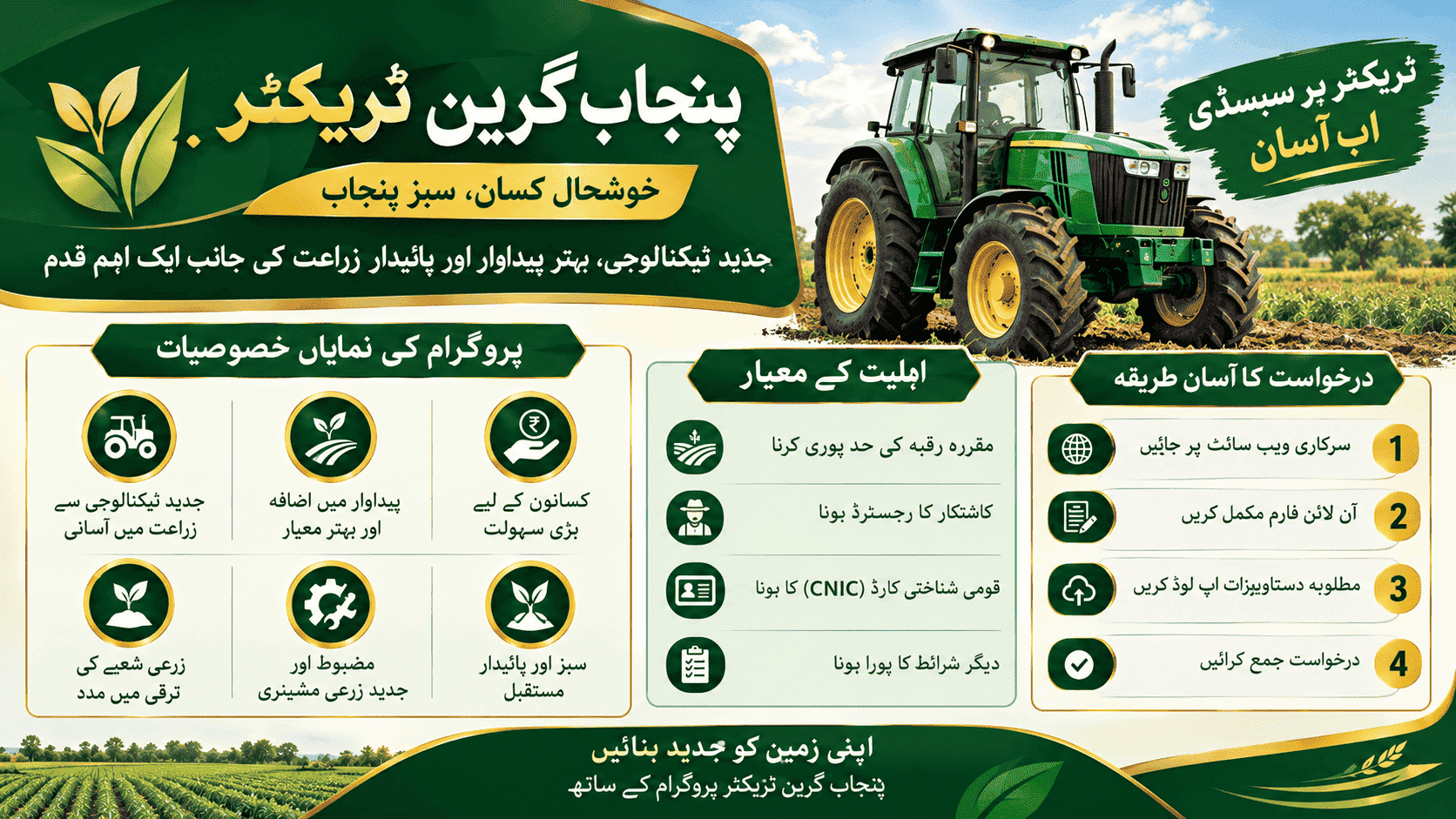
The Punjab Cabinet also approved Rs. 9.5 billion in subsidies for 10,000 high-powered tractors under Phase V of the Chief Minister Punjab Green Tractor Programme. More than 250,000 applications had reportedly been received, according to the cabinet briefing.
These tractor subsidies are a separate programme decision, although they were approved in the same cabinet meeting and align with the broader agricultural modernisation direction.
The cabinet also approved Rs. 7.6 billion for an agricultural transformation project in Thal covering 10,000 acres in Mankera and Layyah, including drip irrigation, solar power and water-storage facilities.
Tourism and Aquaculture
The PIVOT programme also covers tourism and aquaculture.
Including these sectors broadens the programme beyond traditional manufacturing.
Tourism can support employment and local business activity through hospitality, transport, services and related industries. Aquaculture can contribute to food production, processing and potentially export-oriented value chains.
The success of these areas will depend on how individual projects are implemented and how effectively private-sector participation is developed.
Why Export Growth Matters for Pakistan
Exports are an important source of foreign exchange and a key component of long-term economic development.
Pakistan’s ability to expand exports depends on its capacity to produce competitive products, meet international standards, diversify markets and move toward higher-value goods and services.
The Punjab programme therefore has significance beyond individual industrial projects because it focuses on the infrastructure and value chains that can support export growth.
Potential Benefits for Businesses
If the programme is implemented effectively, businesses could potentially benefit from several areas.
Improved Industrial Infrastructure
Better industrial facilities can make it easier for businesses to establish or expand operations.
Better Testing and Certification
Local testing facilities could help exporters meet international product requirements.
More Value Addition
Agricultural and industrial processing can potentially increase the value of products before they reach domestic or foreign markets.
Greater Private Investment
The expected Rs. 906 billion private-sector component could encourage investment in manufacturing, technology and supply chains.
Employment Opportunities
The programme’s expected employment impact could support new opportunities across manufacturing, agriculture, logistics and related services.
Opportunities for SMEs
Small and medium-sized businesses could potentially benefit from e-commerce, export-related facilities, testing services, skills development and industrial clusters, depending on the specific implementation mechanisms.
What Challenges Could Affect the Programme?
The size of the programme does not by itself guarantee economic success.
Implementation
Large development programmes require effective planning, procurement, monitoring and coordination.
Private Investment
The expected Rs. 906 billion private-sector component will depend on businesses actually committing capital to eligible projects and activities.
Energy and Operating Costs
Manufacturers need reliable and competitive operating conditions to remain internationally competitive.
International Standards
Exporters must meet technical, safety, environmental and quality requirements in their target markets.
Logistics
Transportation, warehousing, cold-chain systems and trade procedures can significantly affect export costs.
Policy Continuity
Long-term industrial investment generally requires predictable policies and a stable regulatory environment.
Does the Rs. 2 Trillion Plan Mean Everyone Will Receive Money?
No.
The programme is an industrial development and export promotion initiative, not a universal cash-distribution scheme.
The Rs. 1.995 trillion figure represents expected public and private investment across multiple sectors. It does not mean that every citizen, farmer, worker or business owner will receive a fixed cash amount.
Similarly, the announcement of the overall programme should not be interpreted as an announcement that applications for every component are currently open.
Readers should wait for specific official notifications before applying for any individual facility, subsidy, financing programme or business opportunity.
Is There a Separate Application for the Rs. 2 Trillion Plan?
At the time of the October 2026 cabinet approval, the programme was presented as a broad industrial development and export promotion programme rather than a single public application scheme.
Therefore, there is no basis to claim that every citizen can submit one application to receive a share of the Rs. 1.995 trillion.
Any future application process would depend on the specific project or facility introduced under the programme.
Who Could Potentially Benefit?
Potential beneficiaries may include:
- Manufacturers
- Exporters
- Small and medium-sized businesses
- Agricultural processors
- Farmers involved in relevant value chains
- Horticulture and floriculture businesses
- Garment manufacturers
- Leather and footwear producers
- Sports-goods manufacturers
- Cutlery and tool manufacturers
- Ceramic businesses
- Fan manufacturers
- Skilled workers
- E-commerce businesses
Eligibility, financing and participation conditions will depend on the individual initiative rather than the overall Rs. 1.995 trillion programme.
How to Verify Future Announcements
Because the programme contains multiple components, readers should verify individual announcements before sharing or acting on them.
Check for official information about:
- Registration dates
- Eligibility requirements
- Financing terms
- Subsidies
- Industrial facilities
- Business opportunities
- Training programmes
- Export support
- Application procedures
A general cabinet approval should not be confused with the launch of an individual application portal.
Frequently Asked Questions
What is the Rs. 2 trillion export and industrial plan 2026?
It refers to Punjab’s Rs. 1.995 trillion industrial development and export promotion programme, reported as the PIVOT programme. It was approved in October 2026 and focuses on industrial development, exports, value addition, agriculture, e-commerce and private investment.
Is the Rs. 2 trillion plan a federal government scheme?
No. The Rs. 1.995 trillion programme is a Punjab government initiative. It should not be described as a single federal Rs. 2 trillion package for all of Pakistan.
How much is the Punjab government expected to invest?
The programme envisages approximately Rs. 1.089 trillion from the provincial government.
How much private investment is expected?
Approximately Rs. 906 billion in private-sector investment is envisaged under the programme.
How many jobs are expected?
The programme is expected to create more than 162,000 jobs. This is an expected employment impact, not a current list of government vacancies.
Which sectors are covered?
The programme covers industrial infrastructure, cluster development, export competitiveness, value-chain transformation, agriculture and livestock mechanisation, e-commerce, garments, testing and certification, agricultural processing, skills development, tourism and aquaculture.
Which cities will have agricultural processing parks?
Agricultural processing parks are planned for Sargodha, Khanewal, Okara and Bhakkar.
Is the Rs. 2 trillion programme a cash grant?
No. It is an industrial development and export promotion programme involving planned public investment and expected private-sector investment.
Can businesses apply for the full Rs. 2 trillion?
No. The programme is not a single financing facility in which businesses can apply for the entire amount. Individual projects or facilities may have separate procedures and eligibility requirements when officially launched.
Are 162,000 government jobs currently available?
No. The 162,000-plus figure is an expected job-creation impact associated with the programme, not an announcement of 162,000 open government vacancies.
Final Takeaway
The Rs. 1.995 trillion Punjab industrial development and export promotion programme, commonly referred to as the Rs. 2 trillion industrial and export plan, is a significant economic initiative approved in October 2026.
Its reported PIVOT framework focuses on industrial infrastructure, cluster development, export competitiveness, value addition, agricultural and livestock mechanisation, e-commerce, garments, testing and certification, agricultural processing, tourism, aquaculture and skills development. The programme envisages approximately Rs. 1.089 trillion in provincial government investment and Rs. 906 billion in private-sector investment, with more than 162,000 jobs expected.
The most important point for readers is that this is a Punjab-level industrial and export development programme, not a nationwide cash scheme or a universal Rs. 2 trillion payment programme.
Its ultimate economic impact will depend on implementation, private-sector participation, infrastructure development, financing, productivity improvements and the ability of Pakistani businesses to compete successfully in international markets.
For businesses and readers, the best approach is to treat the October 2026 announcement as the framework for a broad development programme and wait for official details about individual projects, incentives, financing facilities and application procedures before making any claims about eligibility or registration.

Leave a Reply