

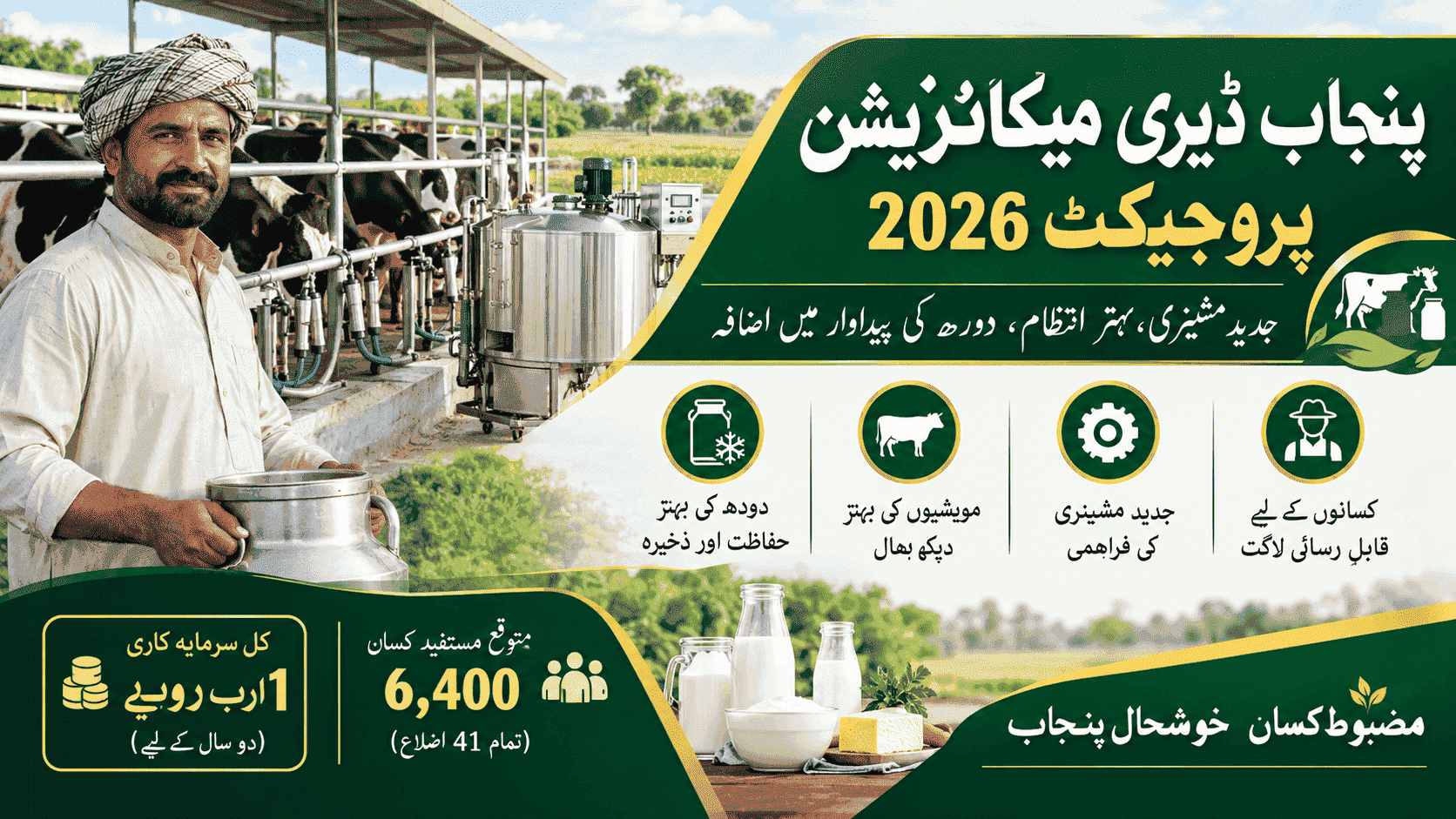
The Punjab Dairy Mechanization Project 2026 is a planned government initiative designed to modernize dairy farming, reduce milk spoilage, and improve productivity across Punjab, Pakistan. According to reports published on October 20, 2026, the provincial government plans to invest Rs. 1 billion over two years to provide subsidized dairy machinery to approximately 6,400 farmers across all 41 districts of Punjab.
Under the reported plan, the government will cover 60% of the eligible machinery cost, while farmers will contribute the remaining 40%. The subsidy is capped at Rs. 500,000 per beneficiary. The project also aims to improve milk handling, refrigeration, processing, and farm management through modern equipment, training, and technical assistance.
Farmers should note that the reported project plan is not the same as an open registration process. The final eligibility criteria, application schedule, approved suppliers, and official application instructions must be confirmed through the relevant government department before applying.
Punjab Dairy Mechanization Project 2026: Key Information
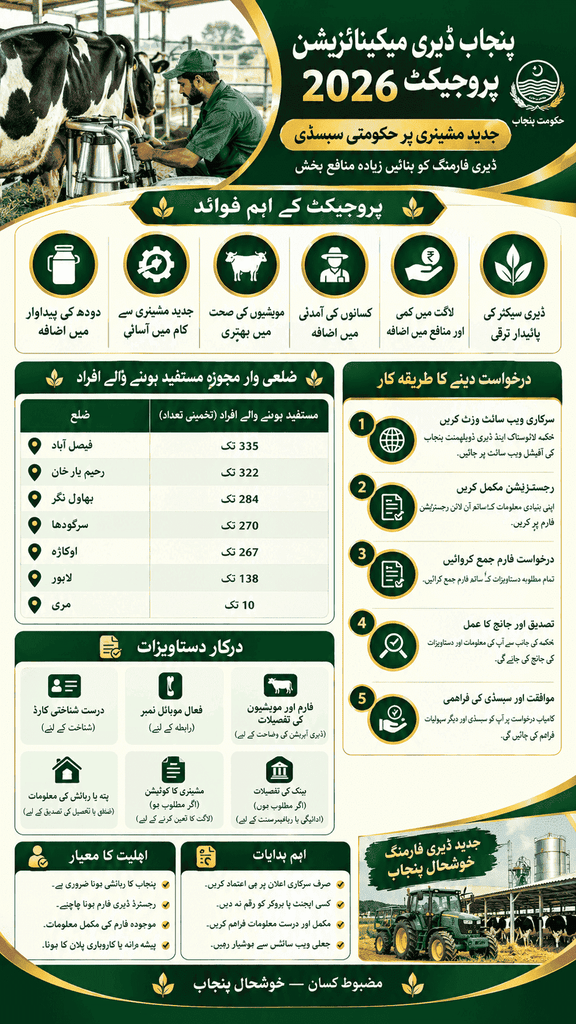
Source: Associated Press of Pakistan reporting published on October 20, 2026, citing the Punjab Livestock Department. These details describe the reported project plan and should not be interpreted as confirmation that applications are open.
What Is the Punjab Dairy Mechanization Project 2026?
The Punjab Dairy Mechanization Project is intended to help dairy farmers adopt modern equipment and improve the way milk is produced, collected, cooled, processed, and stored.
Traditional dairy operations can involve considerable manual labour. Farmers may also face losses when milk is not cooled promptly, equipment is inadequate, or transportation and storage facilities are insufficient.
These challenges can reduce the quantity of milk that reaches buyers in good condition and affect the income of farmers who rely on regular milk sales.
The proposed project aims to address these issues by making selected machinery more affordable through government cost-sharing support. It also envisages training and technical assistance to help farmers and relevant personnel use the equipment effectively.
According to the reported plan, approximately 6,400 farmers are expected to benefit over two years across Punjab’s 41 districts.
Rs. 1 Billion Dairy Project: How Will the Subsidy Work?
The reported subsidy arrangement is designed to share the cost of eligible machinery between the government and the farmer.
Under the proposed structure:
- The government will contribute 60% of the eligible machinery cost.
- The farmer will pay the remaining 40%.
- The government subsidy will not exceed Rs. 500,000 per beneficiary.
- The final amount will depend on the approved equipment, eligible cost, and implementation rules.
Dairy Machinery Subsidy Calculation
The following examples illustrate the reported cost-sharing arrangement.
The final example applies the reported subsidy cap. Although 60% of Rs. 1 million equals Rs. 600,000, the reported maximum subsidy is Rs. 500,000. The farmer would therefore be responsible for the remaining Rs. 500,000 under this illustrative calculation.
These figures are examples, not approved machinery prices or a guarantee of subsidy. The final project rules will determine eligible costs, payment arrangements, and any additional conditions.
First-Year Budget and Project Funding
The reported total investment is Rs. 1 billion over two years.
According to the October 20, 2026, report, Rs. 461 million has been allocated for FY 2026–27, while the remaining funding is earmarked for subsidy disbursement during FY 2027–28.
The allocation indicates that the project is planned as a multi-year initiative rather than a one-time payment to all beneficiaries.
The timing of individual subsidies, the distribution of funding between districts, and the final number of approvals will depend on the project’s implementation arrangements.
Which Dairy Machinery Is Included?
The reported project covers 11 categories of dairy and livestock machinery intended to improve milk production, handling, cooling, processing, storage, and general farm management.
The listed categories are based on published reporting. Exact models, technical specifications, brands, approved suppliers, and final prices have not been established by the reports cited here.
Farmers should wait for the approved machinery list before purchasing equipment in the expectation of receiving a subsidy.
Who Can Benefit From the Punjab Dairy Mechanization Project?
The project is intended to support dairy farmers across Punjab, particularly small and resource-constrained farmers who depend on milk sales for their livelihoods.
However, the complete eligibility criteria have not been confirmed in the reports reviewed. Farmers should not assume that a particular herd size, landholding, income level, or ownership arrangement automatically qualifies them.
Potential Beneficiaries
The project may be relevant to:
- Small-scale dairy farmers seeking to improve daily operations.
- Livestock owners who rely heavily on manual milking.
- Dairy businesses needing better milk cooling and storage equipment.
- Farmers interested in milk processing, yoghurt production, or butter making.
- Livestock producers seeking improved feeding and animal-handling facilities.
These are potential beneficiary groups based on the project objectives, not an official eligibility list. The department’s final criteria will determine who can apply.
District-Wise Expected Beneficiaries
Published reporting identifies projected beneficiary allocations for several districts. These figures represent planned allocations over the two-year period, not a list of approved applicants.
| District | Projected Beneficiaries |
|---|---|
| Faisalabad | Up to 335 |
| Rahim Yar Khan | Up to 322 |
| Bahawalnagar | Up to 284 |
| Sargodha | Up to 270 |
| Okara | Up to 267 |
| Lahore | Up to 138 |
| Murree | Up to 10 |
Faisalabad has the largest reported allocation among the districts listed, while Murree has the smallest. The project is planned to cover all 41 districts of Punjab.
Final allocations and beneficiary numbers should be checked against official implementation documents when they become available.
How to Apply for the Punjab Dairy Mechanization Project 2026
According to the reported implementation plan, farmers are expected to submit applications at the tehsil level. Applications would then be scrutinized, with eligible applicants selected through electronic balloting at the district level.
Important: This is the reported proposed procedure. A confirmed registration opening date, deadline, official application form, and project-specific online portal have not been established in the sources reviewed.
Step 1: Check the Official Announcement
Visit the Punjab Government website and check for announcements from the Punjab Livestock and Dairy Development Department.
Step 2: Contact the Relevant Livestock Office
Ask the relevant district or tehsil-level livestock office whether the application process has formally started and where official forms will be available.
Step 3: Confirm the Eligibility Requirements
Review the official conditions when published. Confirm the eligible machinery categories, subsidy limits, applicant requirements, and any rules about farm ownership or livestock records.
Step 4: Prepare the Required Documents
Keep your CNIC and relevant farm or livestock records available. Obtain machinery quotations only if requested by the official application instructions. Do not treat this preparation list as a final mandatory document checklist.
Step 5: Submit an Application When Registration Opens
If the reported process is adopted, applications will be submitted through the designated tehsil-level procedure. Follow the official instructions and retain the application receipt or reference number.
Step 6: Follow the Verification and Selection Process
According to the reported plan, officials will scrutinize applications before eligible applicants are selected through district-level electronic balloting. Final selection and subsidy disbursement will depend on the official rules.
What Documents May Be Required?
The final document checklist has not been confirmed. The following table lists records farmers may wish to prepare while waiting for the official announcement.
| Document or Record | Possible Purpose |
|---|---|
| Valid CNIC | Identity verification |
| Active mobile number | Application-related communication |
| Farm or livestock details | Describing the dairy operation |
| Address or residence information | Confirming the relevant district or tehsil |
| Machinery quotation, if requested | Establishing the equipment cost |
| Bank details, if requested | Supporting any required payment or reimbursement process |
This is a preparation guide, not an official list of compulsory documents. Follow the final checklist issued by the responsible department.
Major Benefits of the Rs. 1 Billion Dairy Mechanization Project
1. Reduced Milk Spoilage
Milk can deteriorate when it is not handled, cooled, or stored correctly. Access to suitable cooling equipment may help farmers preserve milk quality and reduce losses before sale or processing.
2. Reduced Dependence on Manual Labour
Milking machines and suitable farm equipment can reduce the time and physical effort needed for certain daily activities. This may help farmers manage their operations more efficiently.
3. Improved Milk Handling and Storage
Milk-cooling cans and chillers may support better temperature management when used correctly. Proper cleaning, maintenance, and handling practices remain essential.
4. Opportunities for Value-Added Dairy Products
Heating tanks, butter churners, and packing machines may help eligible businesses process milk into other products and explore additional sources of income.
5. Better Livestock and Feed Management
TMR feed wagons, weighing scales, and mechanical cattle crushes may help improve feeding operations, measurement, and animal handling.
6. Lower Upfront Machinery Costs
Under the reported 60% subsidy structure, the government would share a substantial part of the eligible machinery cost, subject to the Rs. 500,000 cap. Farmers would still need to arrange their own contribution and meet the final eligibility conditions.
7. Training and Technical Assistance
The project also envisages training and technical assistance. This is important because the benefits of machinery depend on correct operation, maintenance, cleaning, and suitability for the farm.
These are expected benefits, not guarantees of increased income or production for every beneficiary.
Why Dairy Mechanization Matters in Punjab
Punjab is a major contributor to Pakistan’s dairy sector. Reporting based on agricultural data indicates that the province accounts for approximately 74% of national milk production.
Improving milk handling, refrigeration, storage, and transportation can therefore have implications beyond individual farms. Reduced spoilage may help farmers retain more saleable milk, while better processing facilities can support businesses throughout the dairy supply chain.
Mechanization alone, however, cannot solve every challenge. Farmers also need reliable access to electricity, cleaning facilities, suitable transport, equipment servicing, and technical guidance.
The project’s proposed training and technical assistance could help farmers make better use of subsidized equipment if these services are implemented effectively.
Important Precautions for Farmers
Before applying or purchasing machinery, farmers should keep the following points in mind:
- Confirm registration status: News reports about a planned project do not mean applications are open.
- Avoid unofficial fees: Do not pay agents who promise guaranteed selection or approval.
- Verify machinery eligibility: Not every model, brand, or supplier will necessarily qualify.
- Understand the subsidy cap: The reported maximum government contribution is Rs. 500,000 per beneficiary.
- Wait for the final eligibility rules: Do not rely on unverified claims about herd size, land ownership, or income.
- Keep official records: Retain application receipts, approved quotations, and payment evidence when the formal process begins.
- Check official instructions: Confirm where to apply, which documents are required, and whether any payment must be made directly to an approved supplier.
For provincial announcements, visit the Punjab Government website. The Punjab Agriculture Department website provides information about agriculture-related programs, but its separate farm mechanization initiatives should not be confused with this dairy project.
No project-specific registration link should be used unless it is confirmed by the responsible department.
Frequently Asked Questions (FAQs)
1. What is the Punjab Dairy Mechanization Project 2026?
It is a planned Rs. 1 billion initiative intended to support approximately 6,400 farmers across Punjab with subsidized dairy machinery over two years.
2. How much subsidy is planned for farmers?
The reported arrangement provides a 60% subsidy on eligible machinery costs, capped at Rs. 500,000 per beneficiary. Farmers would contribute the remaining cost under the proposed arrangement.
3. Are applications open for the project?
The reports published on October 20, 2026, describe the project plan and proposed application procedure. They do not establish a confirmed application opening date or project-specific registration portal.
4. Which department is responsible for the project?
The project has been reported by reference to the Punjab Livestock and Dairy Development Department.
5. How many farmers are expected to benefit?
Approximately 6,400 farmers are expected to receive support across all 41 districts over the planned two-year period.
6. Which machinery categories are included?
The reported categories include single- and double-cluster milking machines, a four-animal bucket milking system, 50-litre cooling cans, milk chillers, 160–200-litre heating tanks, butter churners, semi-automatic packing machines, weighing scales, 13-tonne TMR feed wagons, and mechanical cattle crushes.
7. What is the maximum subsidy available?
The reported subsidy cap is Rs. 500,000 per beneficiary. The final amount will depend on the eligible machinery cost and the approved rules.
8. Will farmers be selected through electronic balloting?
The reported proposed mechanism includes application scrutiny followed by electronic balloting at the district level for eligible applicants. The final procedure and timetable should be confirmed by the department.
9. Is the project a loan or a subsidy?
Published reporting describes a cost-sharing machinery subsidy rather than a loan. Farmers are expected to contribute part of the eligible equipment cost, while the government would provide the subsidy under the proposed conditions.
10. Where can farmers find reliable updates?
Check the Punjab Government website and announcements from the relevant livestock department or local office. Do not trust unofficial links claiming guaranteed registration or selection.
Conclusion
The Punjab Dairy Mechanization Project 2026 is a planned Rs. 1 billion initiative that aims to modernize dairy farming, reduce milk spoilage, and improve farm productivity across Punjab. The reported plan targets approximately 6,400 farmers over two years, with a proposed 60% subsidy on eligible machinery costs and a maximum subsidy of Rs. 500,000 per beneficiary.
The project could help farmers access better milking, cooling, processing, feeding, and animal-handling equipment. Its practical impact will depend on the final eligibility rules, approved machinery, supplier arrangements, training, and effective implementation.
Farmers should verify the official application schedule and requirements before spending money or sharing personal documents. The project should be treated as planned until the department confirms the relevant implementation details.
Disclaimer: Sardar Article is an independent informational website and is not affiliated with the Punjab Government. This article is based on published reporting about the proposed project and is not an official government notification. Confirm important details with the relevant department before taking action.

Leave a Reply