

Introduction
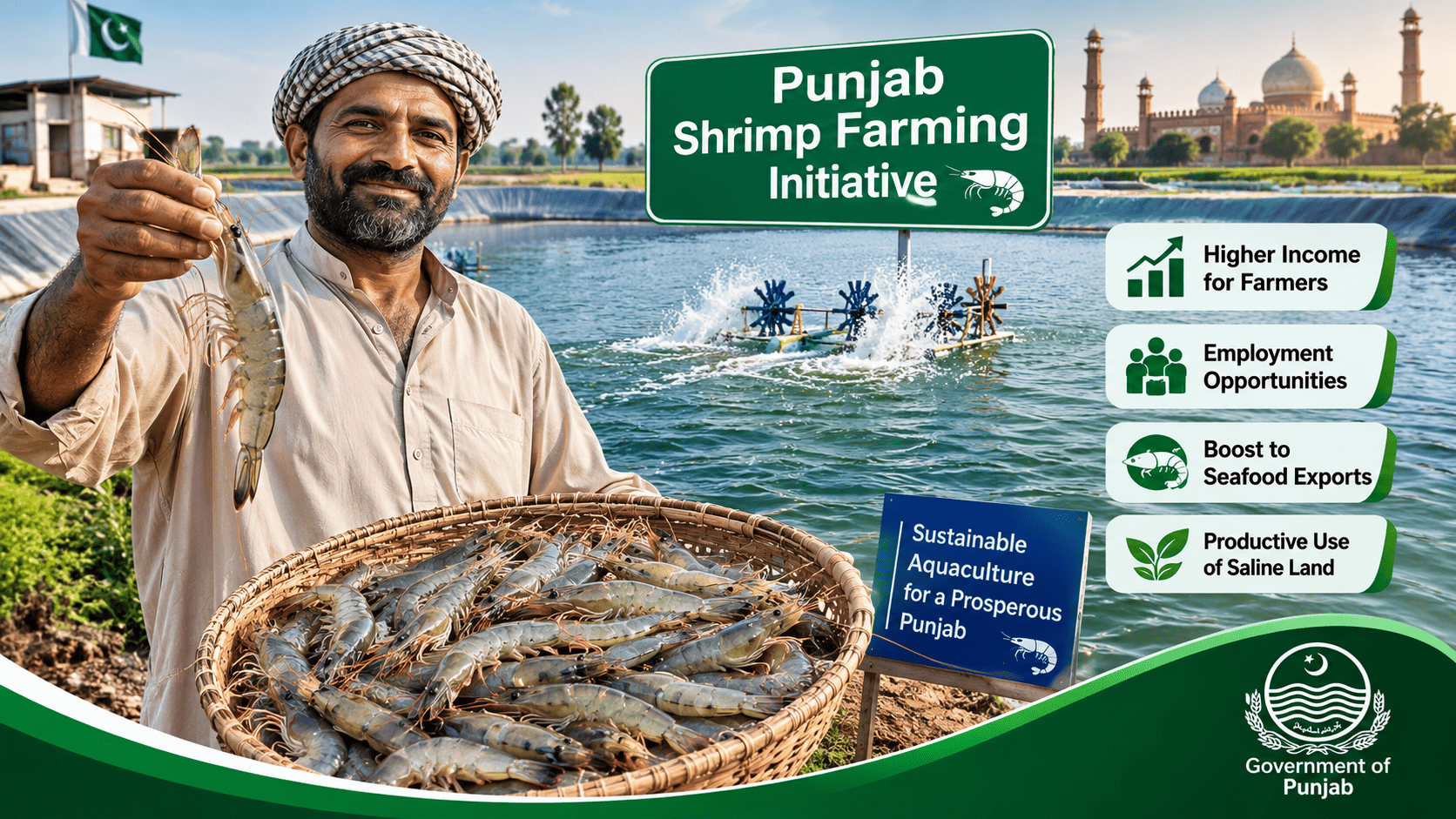
Shrimp Farming Initiative Punjab 2026 is an ambitious aquaculture development program of the Government of Punjab designed to turn suitable saline and underutilized land into productive shrimp farms. The initiative is being implemented through the Punjab Fisheries Department and focuses on developing a complete shrimp industry, from hatcheries and farm production to processing, cold storage, technical training and export markets.
The government formally launched technology-driven shrimp farming in Punjab after a successful pilot project on 100 acres in Muzaffargarh. According to the Punjab government, the pilot demonstrated that shrimp could be produced successfully on saline and barren land and created the foundation for expanding the sector across the province.
The initiative is particularly significant because it offers an alternative use for land where conventional agriculture can be difficult because of salinity. The Punjab Fisheries Department says the project is intended to create rural employment, strengthen food security, generate export revenue and establish a sustainable shrimp value chain in the province.
Shrimp Farming Initiative Punjab 2026 at a Glance
| Program | Shrimp Farming Initiative / Shrimp Aquaculture Development |
|---|---|
| Province | Punjab, Pakistan |
| Implementing Department | Punjab Fisheries Department |
| Project Period | 2024-25 to 2027-28 |
| Official Project Focus | Shrimp aquaculture, farm development and value-chain expansion |
| Key Areas | Shrimp farms, hatcheries, research, training, processing, feed and cold storage |
| Proposed Farmer Support | Seed/feed subsidy and financial support for farm development |
| Target | Development of a sustainable shrimp aquaculture industry in Punjab |
What Is the Shrimp Farming Initiative?
The Shrimp Farming Initiative is a major aquaculture development effort aimed at establishing shrimp production as a new commercial sector in Punjab. Instead of limiting shrimp farming to traditional coastal locations, the project is based on the use of suitable inland saline and brackish-water areas.
The Punjab Fisheries Department explains that Punjab has extensive saline and brackish-water areas that can provide opportunities for shrimp production. The initiative combines scientific research, modern aquaculture technology, technical services and financial support to develop the industry.
The government is also working toward creating an integrated value chain. This means the project is not limited to digging ponds and raising shrimp. It includes hatchery development, feed production, processing facilities, cold storage, quality control, training and market access.
Why Is Punjab Promoting Shrimp Farming?
Traditional agriculture is not equally productive on every piece of land. Areas affected by salinity can present serious challenges for conventional crops. Shrimp aquaculture provides an opportunity to make productive use of some of these locations when technical and environmental assessments confirm that the land and water are suitable.
The government sees shrimp aquaculture as a potential contributor to Punjab’s emerging blue economy. The official project objectives include employment creation, food security, export earnings, technology transfer and rural livelihood development.
Main Reasons Behind the Initiative
- To make productive use of suitable saline and barren land.
- To develop a new high-value aquaculture industry in Punjab.
- To create employment opportunities in rural areas.
- To support farmers interested in alternative agricultural enterprises.
- To develop local shrimp seed and feed supply.
- To establish processing and cold-storage infrastructure.
- To improve access to domestic and international seafood markets.
- To generate export revenue for the province.
Successful Pilot Project
The shrimp initiative was preceded by a pilot project in Muzaffargarh. The Punjab Fisheries Department reports that shrimp farming was formally initiated in 2024 and that the pilot covered 100 acres of saline and barren land. The results were described as positive, with production considered suitable for both domestic consumption and export markets.
Following the pilot, the government moved toward a larger technology-based shrimp aquaculture program. In December 2025, the Punjab government announced the formal launch of the shrimp farming industry and said that shrimp estates covering 5,300 acres in Muzaffargarh and Sargodha were planned for launch by March 2026.
Major Components of the Shrimp Farming Program
1. Shrimp Farm Development
A central component of the initiative is the development of dedicated shrimp farms. The official project description includes development of shrimp farms and support for private-sector participation.
The Fisheries Department’s project page describes a plan for shrimp farms covering 1,000 acres, with government technical support and private-sector involvement.
2. Shrimp Hatcheries
A reliable supply of healthy shrimp seed is essential for commercial aquaculture. The initiative therefore includes the development of shrimp hatchery capacity in Punjab.
The official project information includes a dedicated shrimp hatchery component intended to strengthen local seed production and reduce dependence on external sources.
3. Research and Training Center
The government plans to strengthen research, training and technical capacity through a shrimp research and training center in Muzaffargarh. This is intended to help farmers and technical teams adopt modern shrimp-farming methods.
4. Quality Control and Laboratory Facilities
Shrimp production requires careful monitoring of water quality, animal health and food safety. The initiative therefore includes strengthening quality-control laboratories and related technical facilities.
5. Processing and Cold Storage
A successful shrimp industry requires infrastructure beyond the farm. Processing facilities and cold storage can help preserve product quality and support access to domestic and export markets.
6. Feed Production
Feed is one of the most important operating inputs in intensive aquaculture. The project includes support for shrimp feed mills as part of the wider value-chain development strategy.
7. Technical Training
Modern shrimp farming requires knowledge of pond preparation, water quality, stocking, feeding, disease management and harvesting. The project therefore includes human-resource development, training and technology-transfer activities.
Financial Support for Shrimp Farmers
One of the most important features of the initiative is financial support for private shrimp farmers. The official Punjab Fisheries project page lists a subsidy component for shrimp farmers and also describes soft financing for different parts of the shrimp value chain.
Seed and Feed Subsidy
The official project description provides for a subsidy for shrimp seed and feed. It states a planned support level of Rs. 0.8 million per acre, covering a total of 2,500 acres over four years. The precise availability of support should be confirmed with the Fisheries Department because implementation, approved locations and application conditions can change.
Soft Financing for Value-Chain Development
The official project information also describes proposed zero-interest soft financing for shrimp value-chain development. The listed components include hatcheries, processing and cold-storage facilities, feed mills and farm construction or operation.
According to the project page, farm-related financing is described at up to Rs. 2.5 million per acre, with support for up to 10 acres per farmer under the stated project framework. Applicants should verify the current terms and availability directly with the Punjab Fisheries Department before making any financial commitment.
Who May Benefit From the Initiative?
The initiative is designed to support the development of shrimp aquaculture rather than provide a universal cash grant to every farmer in Punjab. Potential beneficiaries can include farmers and private investors who meet the project’s technical, land, environmental and administrative requirements.
Suitable land and water conditions are particularly important. A farmer should not assume that every agricultural plot qualifies simply because it is located in Punjab.
Potentially Relevant Applicants
- Farmers with suitable saline or brackish land.
- Landowners interested in commercial aquaculture.
- Private investors developing shrimp farms.
- Entrepreneurs interested in shrimp hatcheries.
- Businesses planning processing or cold-storage facilities.
- Investors interested in shrimp feed production.
Possible Eligibility Requirements
The exact eligibility conditions can depend on the particular component of the project for which an applicant seeks support. For example, requirements for a shrimp-farm subsidy may differ from requirements for a hatchery, processing facility or value-chain loan.
Applicants should be prepared to provide information such as:
- Valid CNIC and applicant information.
- Proof of land ownership, lease or lawful possession where applicable.
- Land location and area details.
- Information about the proposed shrimp farm.
- Water and soil information when required.
- Banking and financial information for financing-related applications.
- Business or investment details where required.
- Any technical documents requested by the Fisheries Department.
These should be treated as preparation guidance rather than a fixed universal checklist. Applicants should obtain the current official requirements before submitting an application.
How to Apply for the Shrimp Farming Initiative
The shrimp initiative is administered through the Punjab Fisheries Department. Because the program contains several different components, the application route can depend on whether an applicant is seeking farm development support, subsidy, financing, training or another service.
- Visit the official Fisheries Department website.
- Review the shrimp aquaculture information. Check the latest project announcements, eligibility requirements and application instructions.
- Determine your project category. Identify whether you are interested in farm development, subsidy, financing, hatchery development or another component.
- Prepare land and personal documents. Keep CNIC, land records and other required information available.
- Confirm technical suitability. The proposed site should meet the relevant water, soil and environmental requirements.
- Submit the application through the officially announced channel.
- Complete verification. Government officials or technical teams may evaluate the proposed site and documents.
- Wait for official approval. Financial assistance should only be considered available after the relevant authority formally approves the application.
Important Note About Online Applications
At the time of publication, the official Punjab Fisheries Department information confirms the shrimp aquaculture project and its financial-support framework, but the exact online application mechanism can vary by project component. Therefore, readers should not submit personal information to unofficial websites claiming to process shrimp-farming applications.
The safest approach is to start from the official Punjab Fisheries Department website and follow the latest instructions issued by the department.
Benefits of Shrimp Farming for Punjab
Better Use of Saline Land
Shrimp farming can create an alternative economic use for suitable saline areas where conventional crop production may be difficult.
Employment Generation
The development of shrimp estates, hatcheries, processing plants, feed mills and transport networks can create employment across several stages of the value chain.
Export Opportunities
The government intends to develop shrimp production for both domestic and international markets. Export-oriented production can potentially create a new source of foreign-exchange earnings.
Rural Economic Development
Shrimp aquaculture can create business opportunities in areas where agricultural productivity is constrained by soil or water conditions.
Technology Transfer
The initiative includes technical experts, research facilities and training activities intended to introduce modern aquaculture practices to Punjab.
Role of Technology in Shrimp Farming
The Punjab government describes the initiative as technology-driven. Modern shrimp farming depends on accurate monitoring of water quality, temperature, salinity, oxygen, feeding and animal health.
Technology can also help farmers identify problems earlier, manage feeding more efficiently and maintain consistent production conditions. The government’s project includes technical services and international expertise covering shrimp breeding, farm design, health management, processing, food safety and market competitiveness.
Environmental Considerations
Shrimp farming can provide economic benefits, but responsible aquaculture requires careful environmental management. Water quality, pond design, waste management, disease control and responsible use of inputs are essential for long-term sustainability.
The Punjab Fisheries Department specifically lists environmental sustainability, best practices and innovation among the objectives of the shrimp aquaculture initiative.
For this reason, farmers should follow the technical standards and environmental instructions issued by the Fisheries Department instead of attempting commercial shrimp farming without professional guidance.
Difference Between Shrimp Farming and Traditional Fish Farming
| Feature | Shrimp Aquaculture | Traditional Fish Farming |
|---|---|---|
| Water Conditions | Can use suitable saline/brackish water conditions | Generally uses freshwater systems for common species |
| Main Focus | Commercial shrimp production | Production of different fish species |
| Technical Requirements | Requires careful water and health management | Requirements vary according to species and farming system |
| Market Potential | Domestic and export seafood markets | Primarily domestic markets, depending on species |
Current Project Scale
The Punjab government’s shrimp program has moved beyond the initial pilot stage. Official information describes a province-wide development strategy involving farms, hatcheries, research facilities, processing infrastructure, training and private investment.
The Punjab Planning and Development Department’s development documentation also lists Aquaculture: Shrimp Farming in Punjab as an ongoing scheme, demonstrating that the initiative forms part of the province’s formal development program.
Frequently Asked Questions
What is the Shrimp Farming Initiative in Punjab?
It is a Punjab government aquaculture initiative designed to develop commercial shrimp production using suitable saline and brackish-water areas while creating a broader shrimp value chain.
When did shrimp farming start in Punjab?
The Punjab Fisheries Department says shrimp farming was formally initiated in 2024, beginning with a 100-acre pilot project in Muzaffargarh.
Who is implementing the shrimp farming project?
The initiative is being implemented through the Punjab Fisheries Department under the Government of Punjab.
Does the government provide financial support to shrimp farmers?
Yes. The official project information includes subsidy support for shrimp seed and feed and describes financial assistance for shrimp-farm development and other parts of the value chain.
How much subsidy is available?
The official project page describes planned seed and feed subsidy support of Rs. 0.8 million per acre under its stated framework. However, applicants should verify the currently available amount and applicable conditions before applying.
Can any farmer in Punjab start shrimp farming?
No. Shrimp farming requires appropriate land, water and technical conditions. Eligibility for government support can also depend on the specific project component and official selection criteria.
Is the project only for farmers?
No. The broader initiative also includes opportunities and infrastructure for private investors, hatcheries, processing units, feed mills, cold storage and other parts of the shrimp value chain.
Where can I get official information?
The Punjab Fisheries Department is the appropriate official source for current shrimp aquaculture information, project updates and application instructions.
Important Advice for Applicants
Before investing money in shrimp farming, prospective applicants should first confirm that their land is technically suitable and that they qualify for the relevant government support. Do not rely on social-media advertisements or unofficial agents promising guaranteed subsidies or loans.
Applicants should also remember that a project announcement does not automatically mean that every component is open for applications at all times. Availability, quotas, geographic coverage, financial terms and verification requirements can change as the program is implemented.
Conclusion
The Shrimp Farming Initiative Punjab 2026 represents a significant shift toward commercial aquaculture and alternative land use in Punjab. By combining shrimp farms with hatcheries, research, training, processing, feed production, cold storage and financial support, the government is attempting to build an integrated industry rather than simply distribute assistance to individual farmers.
Farmers and applicants who want to explore other Punjab government support initiatives can also learn about Maryam Ko Bataye Helpline 1000, a citizen-support service that provides a convenient channel for reporting complaints, requests, and government-service concerns.
The initiative could create new opportunities for farmers and investors, particularly in areas where salinity makes conventional agriculture less productive. At the same time, successful participation requires suitable land, proper technical management, environmental responsibility and compliance with official requirements.
Anyone interested in joining the program should use the official Punjab Fisheries Department channel, verify the latest eligibility and application instructions, and avoid paying unauthorized agents for guaranteed approval.
Disclaimer: This article is provided for informational purposes. Government schemes, subsidies, financing arrangements, eligibility criteria and application procedures may change. Applicants should verify the latest information directly through the official Punjab Fisheries Department before submitting documents, investing money or entering into any financial arrangement.









Leave a Reply