

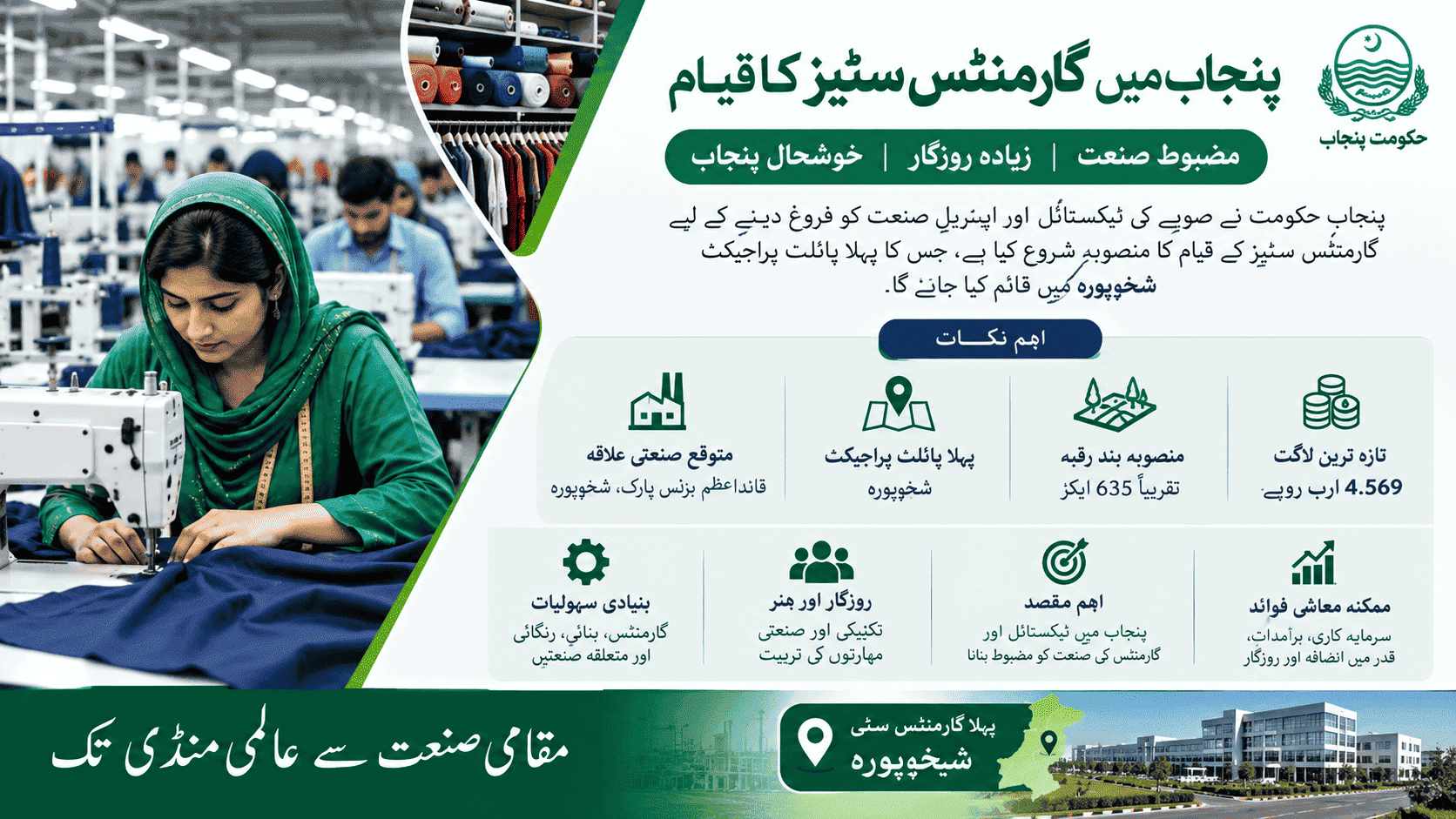
Punjab is moving forward with the Establishment of Garment Cities in Punjab, an industrial development initiative aimed at strengthening the province’s textile and apparel sector. The project is designed around the development of dedicated facilities for garment and related textile businesses, with the first plug-and-play Garment City planned in Sheikhupura.
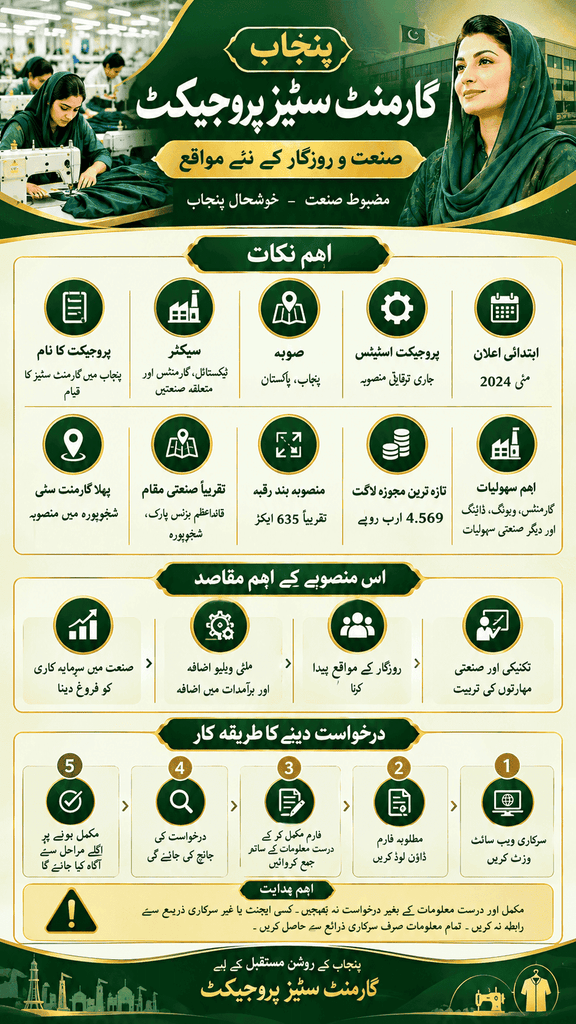
The Government of Punjab announced the first plug-and-play Garment City in May 2024 and stated that the project would provide facilities for garment-related industries, including weaving, dyeing and other supporting units. The government also highlighted technical training for workers and indicated that additional garment cities could be developed after the success of the pilot project.
The project has since remained part of Punjab’s development program. The latest Provincial Development Working Party reporting in October 2026 lists the Establishment of Garment Cities in Punjab (Revised) with a revised cost of Rs. 4.569 billion.
Punjab Garment Cities Project – Key Information
The following table summarizes the currently available official information about the project:
The Punjab Board of Investment & Trade has described the planned Punjab Garments City as a plug-and-play model covering approximately 635 acres at Quaid-e-Azam Business Park, an operational Special Economic Zone in Punjab.
What Is the Punjab Garment Cities Project?
The Punjab Garment Cities Project is an industrial development initiative focused on creating dedicated locations for garment and textile-related businesses.
Rather than treating garment manufacturing as isolated factory activity, the garment-city model is intended to create an organized industrial ecosystem where different parts of the textile and apparel value chain can operate in closer proximity.
The concept can include manufacturing facilities as well as supporting activities such as weaving, dyeing, processing and other related operations.
The project is particularly relevant to Punjab because the province already has a large textile manufacturing base. According to the Punjab Board of Investment & Trade, around 70% of Pakistan’s textile industries are located in Punjab.
Where Is the First Garment City Planned?
The first plug-and-play Garment City announced by the Punjab government is planned at Quaid-e-Azam Business Park in Sheikhupura.
Punjab’s development records also identify Sheikhupura as the location associated with the Garment Cities scheme.
Quaid-e-Azam Business Park is an established Special Economic Zone with industrial infrastructure and motorway connectivity. The Punjab government describes the business park as being located along the Lahore-Islamabad Motorway in Sheikhupura and connected to major cities, ports and dry ports through the national road network.
This location can provide logistical advantages for businesses involved in manufacturing, transportation and distribution.
Why Punjab Is Developing Garment Cities
Punjab already has a significant textile industry, but there is considerable potential to increase production of value-added textile and apparel products.
Garment manufacturing takes textile materials further along the value chain. Instead of selling only raw materials, yarn or fabric, businesses can produce finished clothing and other apparel products for domestic and international markets.
The garment-city initiative can therefore support a more integrated industrial ecosystem.
Strengthening Value-Added Manufacturing
The development of garment-focused industrial facilities can encourage greater production of finished and semi-finished textile products.
Potential activities can include:
- Garment manufacturing
- Weaving
- Dyeing
- Textile processing
- Apparel finishing
- Packaging
- Supporting textile operations
This can help businesses participate in more stages of the textile value chain.
Supporting Industrial Investment
A dedicated industrial location can make it easier for companies to identify suitable space and facilities for production.
The plug-and-play approach is particularly relevant because businesses generally require access to infrastructure, utilities, transportation and supporting industrial services before establishing or expanding manufacturing operations.
Employment Opportunities Through Garment Cities
Employment is one of the major potential benefits of expanding garment manufacturing.
The government specifically highlighted technical training for workers when announcing the first plug-and-play Garment City in 2024.
As garment manufacturing develops, employment can potentially emerge across different stages of production.
Direct Manufacturing Jobs
Garment and textile facilities can require workers for activities such as:
- Cutting
- Stitching
- Machine operation
- Fabric inspection
- Quality control
- Dyeing
- Finishing
- Packaging
- Production supervision
The exact number and type of jobs will depend on the businesses established within the project.
Supporting Employment
Industrial development can also generate demand for supporting services.
These may include:
- Transportation
- Warehousing
- Maintenance
- Security
- Packaging
- Equipment servicing
- Logistics
- Industrial support services
Therefore, the economic impact of a garment city can extend beyond the factories themselves.
Technical Training for Garment Workers
A trained workforce is essential for the success of modern textile and apparel manufacturing.
When the first plug-and-play Garment City was announced, the Punjab government specifically directed authorities to organize technical training for garment-industry workers.
Training can help workers develop practical skills in areas such as:
Garment Production Skills
Workers may require training in:
- Industrial stitching
- Cutting techniques
- Sewing-machine operation
- Pattern preparation
- Garment finishing
- Quality inspection
Textile Processing Skills
Because the planned facilities can include weaving and dyeing-related activities, workers may also need specialized technical skills for textile processing and production.
Industrial Management Skills
The growth of larger production facilities can also increase demand for people trained in:
- Production planning
- Quality management
- Inventory control
- Workplace safety
- Warehouse operations
A stronger technical workforce can help manufacturers improve productivity and maintain consistent quality.
Opportunities for Textile and Garment Businesses
The Garment Cities Project can potentially create opportunities for both established businesses and new industrial investors.
Garment Manufacturers
Companies involved in apparel production can benefit from access to an industrial environment specifically designed around textile and garment activities.
Potential products can include:
- Ready-made clothing
- Uniforms
- Sportswear
- Workwear
- Children’s clothing
- Fashion apparel
- Other textile-based products
However, individual businesses will need to meet the applicable government, industrial and regulatory requirements.
Textile Processing Businesses
The planned garment-city model also includes related textile activities.
The Punjab government has previously stated that facilities such as weaving and dyeing would be established as part of the first plug-and-play Garment City.
This can help connect textile processing more closely with garment manufacturing.
Supporting Businesses
A larger industrial cluster can also create opportunities for companies providing:
- Packaging
- Logistics
- Warehousing
- Machinery maintenance
- Textile accessories
- Transportation
- Industrial services
The development of these supporting businesses can strengthen the overall supply chain.
Role of Quaid-e-Azam Business Park
Quaid-e-Azam Business Park is important to the project because the Punjab government has identified it as the location for the planned Punjab Garments City.
The business park itself covers approximately 1,536 acres and is described by the Punjab government as a Special Economic Zone with motorway access and connections to major cities, ports and dry ports.
The wider industrial environment can potentially support businesses that need access to transportation and other industrial infrastructure.
Potential Impact on Textile Exports
Pakistan’s textile industry is already an important part of the country’s export economy.
Punjab’s investment authorities identify textile and value-added garments as major investment areas and highlight the potential of finished textile products in international markets.
Garment cities can contribute to this objective by supporting production of higher-value apparel products.
From Fabric to Finished Products
The textile value chain can involve several stages:
Cotton and Raw Materials → Yarn → Fabric → Processing → Garment Manufacturing → Finishing → Packaging → Domestic or Export Markets
Increasing the capacity for garment manufacturing allows businesses to move further toward finished products.
This can potentially increase the value generated from textile materials and create opportunities for export-oriented manufacturers.
Importance of Industrial Infrastructure
Successful garment manufacturing requires reliable infrastructure.
Businesses may need access to:
- Electricity
- Water
- Roads
- Industrial buildings
- Waste management
- Transportation
- Warehousing
- Communication facilities
The plug-and-play concept is intended to provide an industrial environment where businesses can establish operations more efficiently.
The precise facilities available to individual businesses will depend on the project’s final implementation and official arrangements.
Environmental Considerations
Garment and textile manufacturing must also consider environmental management, particularly in activities such as dyeing and textile processing.
Responsible industrial development can involve:
- Proper wastewater treatment
- Efficient water use
- Waste management
- Energy efficiency
- Safe handling of industrial chemicals
- Recycling and resource recovery
Pakistan’s national textile and apparel policy has also recognized the importance of combined effluent treatment and water-recycling facilities in textile and garment cities.
What Makes the Project Different From a Regular Industrial Area?
A conventional industrial area can contain businesses from many different sectors.
A garment city, by contrast, is designed around the textile and apparel ecosystem.
This specialization can make it easier for manufacturers and supporting businesses to interact with one another.
For example, a garment manufacturer can potentially source textile processing, accessories, packaging or logistics services from businesses operating within the wider industrial cluster.
Such concentration can improve supply-chain coordination and create opportunities for specialized businesses.
Current Project Status
The Establishment of Garment Cities in Punjab is listed as an ongoing development scheme by Punjab’s Industries, Commerce & Investment Department.
The project’s development cost has been revised during the planning process. The Provincial Development Working Party reported in October 2026 that the revised cost of the scheme was Rs. 4.569 billion.
This is important because older reports and planning documents may contain different cost figures. Readers should therefore rely on the latest official project information when evaluating the scheme.
What Businesses Should Know Before Making an Investment
Businesses interested in the project should not assume that general information about the Garment Cities Project automatically means applications or industrial plots are currently available.
Before making any investment decision, businesses should verify:
- Official project status
- Location and available industrial space
- Eligibility requirements
- Allocation or leasing procedure
- Applicable fees and charges
- Utility arrangements
- Regulatory requirements
- Environmental requirements
- Available incentives, if officially announced
- Relevant government department or project authority
Applicants and investors should use official government announcements for these details.
Is There an Online Application Form?
The information currently available confirms the development of the Garment Cities project, but the article should not claim that a general public online application portal is available unless the Punjab government officially announces one.
Similarly, applicants should not pay an agent or intermediary simply because someone claims to be accepting applications for the Garment City.
Any application procedure, industrial-unit allocation, plot availability or investment process should be verified through the relevant official authority.
Important Warning for Investors and Businesses
The Garment Cities Project should not be confused with unrelated Punjab loan schemes or private investment advertisements.
If a website, social-media page or individual claims to offer guaranteed plots, jobs, loans or special approval under the Garment Cities Project, verify the claim through an official Punjab government source before providing documents or money.
Do not share sensitive personal or financial information with an unverified agent.
Frequently Asked Questions
What is the Punjab Garment Cities Project?
The Punjab Garment Cities Project is an industrial development initiative focused on establishing dedicated facilities for garment, textile and related industries in Punjab.
Where is the first Punjab Garment City planned?
The first plug-and-play Garment City announced by the Punjab government is planned at Quaid-e-Azam Business Park in Sheikhupura.
What is the latest reported cost of the project?
The Provincial Development Working Party reported a revised cost of Rs. 4.569 billion for the Establishment of Garment Cities in Punjab in October 2026.
What facilities are planned for the Garment City?
The Punjab government has previously mentioned facilities including sheds, weaving, dyeing and other related units as part of the first plug-and-play Garment City.
Can the project create employment?
The project has the potential to create direct and indirect employment through garment manufacturing, textile processing and supporting industrial services. The Punjab government has also highlighted technical training for garment-industry workers.
Will more Garment Cities be established in Punjab?
The Punjab government stated that additional garment cities could be established in other areas after the success of the first pilot project.
Can anyone currently apply for a Garment City plot or unit?
The availability of plots, units and any application process should be confirmed through the relevant official government authority. Readers should not rely on unofficial agents or social-media advertisements.
Final Thoughts
The Punjab Garment Cities Project is an important industrial initiative aimed at strengthening Punjab’s textile and apparel ecosystem. The first plug-and-play Garment City planned at Sheikhupura’s Quaid-e-Azam Business Park is intended to provide a dedicated environment for garment and related textile activities.
The project can support value-added manufacturing, industrial investment, workforce development and employment while potentially strengthening Pakistan’s position in international textile and apparel markets. Its long-term impact, however, will depend on successful implementation, infrastructure, private-sector participation, skilled workforce development and effective industrial management.
For businesses and potential investors, the safest approach is to follow official announcements from the Government of Punjab and relevant industrial authorities and verify all application, allocation, investment and eligibility information before taking any financial or legal step.

Leave a Reply