

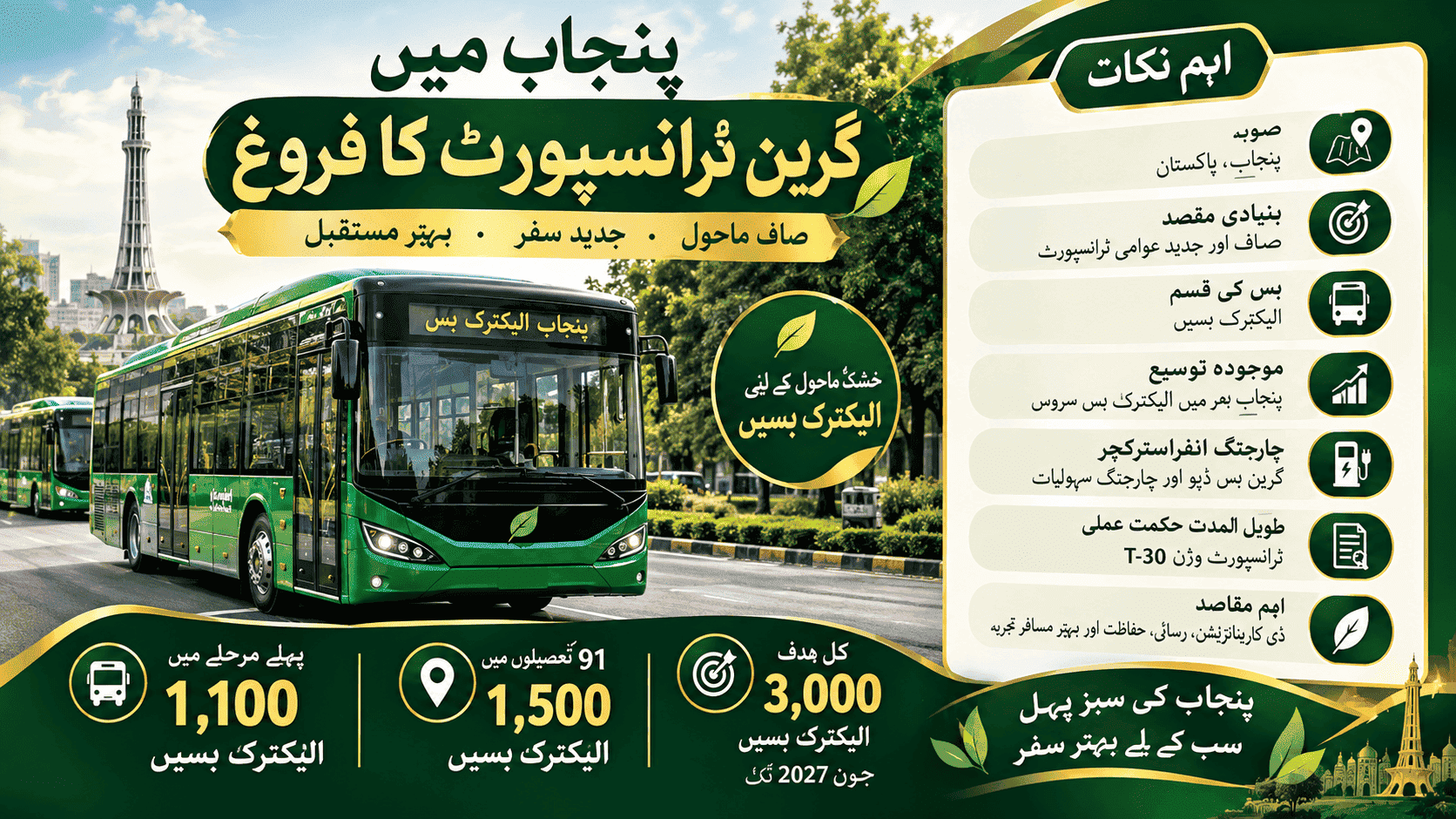
Punjab is rapidly expanding its clean public transportation network through electric buses, dedicated charging facilities, green bus depots, and a long-term strategy for sustainable urban mobility. The initiative is designed to provide modern and affordable public transport while supporting efforts to reduce emissions and improve the overall quality of transportation services across the province.
The expansion is moving beyond major cities. Punjab has already introduced electric-bus services in different areas, while the government has announced further expansion toward districts and tehsil headquarters. According to recent government announcements, the province is targeting 3,000 electric buses by June 2027, while a separate plan calls for electric-bus services in 91 tehsils from January 2027.
Punjab Green Transport Fleet Expansion – Key Details
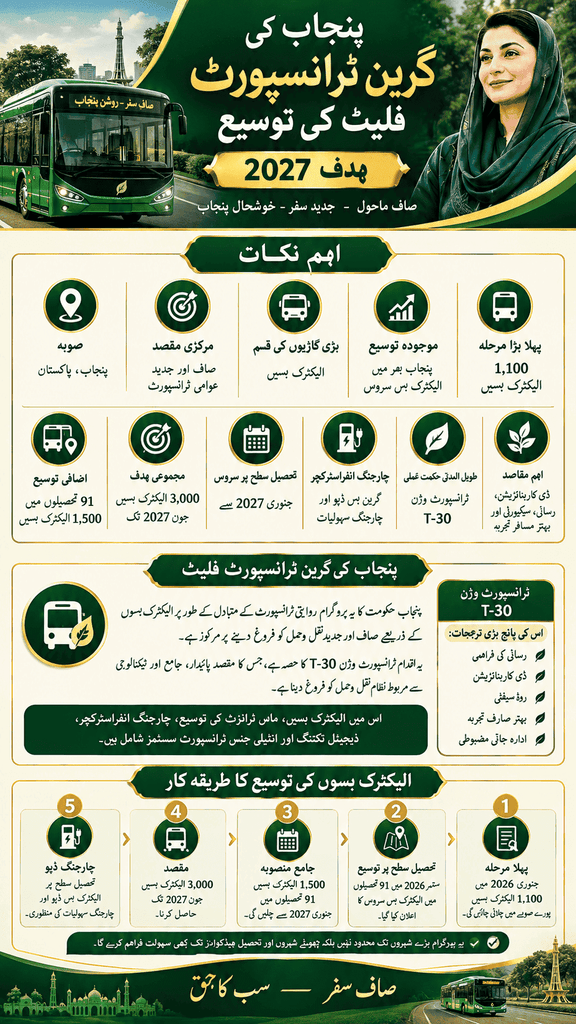
Punjab’s Green Transport Expansion
Punjab’s green transport programme is centered on replacing or supplementing conventional public transport with cleaner mobility solutions, particularly electric buses.
The initiative is part of the province’s wider Transport Vision T-30, which aims to modernize the transport sector through sustainable, inclusive and technology-driven solutions.
The official transport vision identifies five major priorities:
- Provision of access
- Decarbonization
- Road safety
- Improved customer experience
- Institutional strengthening
It also includes electric buses, mass-transit expansion, electric-vehicle charging infrastructure, digital ticketing and intelligent transport systems.
Electric Bus Expansion Across Punjab
The electric-bus programme is being implemented in stages rather than through one single fleet deployment.
In January 2026, Punjab’s Transport and Mass Transit Department stated that 1,100 electric buses would be introduced across the province as the first major phase. The department also indicated that a further expansion would follow.
By September 2026, the provincial government had announced a broader plan to extend electric-bus services to every tehsil.
1,500 Electric Buses for 91 Tehsils
A September 2026 government announcement stated that electric-bus services would be launched at the tehsil level from January 2027.
Under the plan, 1,500 electric buses are to be deployed across 91 tehsils of Punjab. Dedicated electric-bus depots have also been approved for the tehsil-level service.
This is particularly significant because the programme moves beyond large metropolitan centres and aims to provide modern public transport in smaller urban areas.
Target of 3,000 Electric Buses
The same September announcement set a target of increasing Punjab’s total number of electric buses to 3,000 by June 2027.
This target represents the province’s broader expansion strategy rather than a claim that all 3,000 buses are already operating.
The government has also directed that the first phase of the electric-bus programme be completed according to its implementation schedule.
Electric Buses Already Reaching Different Cities
Punjab’s green transport expansion is already visible in several cities and districts.
The provincial Transport Department lists the Induction of Eco-Friendly Buses in Cities of Punjab among its ongoing initiatives. Other transport projects are being developed alongside the electric-bus programme, including urban bus depots and related infrastructure.
Recent developments also show that electric-bus services are being introduced in different regions.
For example, 45 electric buses had been received for Multan, with five routes planned for the city’s electric-bus service in September 2026.
These developments demonstrate that Punjab’s clean transportation strategy is being implemented across multiple locations rather than being limited to Lahore.
Lahore’s Role in Punjab’s Electric Transport Programme
Lahore has been an important testing ground for Punjab’s electric public transport expansion.
The initial pilot involved 27 electric buses, helping authorities evaluate the practical requirements of operating electric public transportation.
The pilot approach is important because successful electric-bus operations require more than vehicles. Authorities must also consider:
- Charging requirements
- Depot design
- Route length
- Passenger demand
- Maintenance
- Driver and technical staff training
- Operational scheduling
Lessons from early projects can help Punjab improve future deployments in other cities and tehsils.
Green Bus Depots and Charging Infrastructure
A larger electric-bus fleet requires supporting infrastructure.
Electric buses cannot operate efficiently without properly designed charging facilities and depots. Punjab is therefore developing green bus depots to support the expansion.
The provincial Transport Department also lists urban bus depot and allied infrastructure projects among its ongoing transport initiatives.
Charging infrastructure will be particularly important as the number of electric buses increases.
Why Charging Facilities Matter
A charging network helps transport authorities:
- Recharge buses between operating shifts
- Maintain regular route schedules
- Reduce unnecessary downtime
- Manage larger electric fleets
- Support long-term expansion
The government has also invited investment and cooperation in electric-vehicle charging infrastructure as part of its wider move toward electric mobility.
Benefits of Punjab’s Green Mobility Expansion
The expansion of electric public transport can provide several environmental and transportation benefits.
Cleaner Urban Transportation
Electric buses do not produce direct tailpipe emissions while operating.
Increasing their use in densely populated urban areas can therefore support broader efforts to improve air quality.
Reduced Transport Noise
Electric buses can also provide quieter operation compared with conventional fuel-powered buses.
This can make public transport more comfortable for passengers and potentially reduce transport noise in busy urban areas.
Modern Public Transport
New electric buses can be combined with improved transport infrastructure, digital ticketing and intelligent transport systems.
Punjab’s Transport Vision T-30 specifically includes technology-driven solutions and improved customer experience as major priorities.
Better Access to Public Transportation
Expanding services toward tehsil headquarters could give more people access to organized public transportation.
This can be especially useful for:
- Students
- Office workers
- Women
- Senior citizens
- Daily commuters
- People without private vehicles
Punjab’s Long-Term Transport Vision
The electric-bus programme forms part of a much larger transport strategy.
Punjab’s Transport Vision T-30 is intended to modernize and green the province’s transport sector by 2030.
Major Components of Transport Vision T-30
The official roadmap includes:
- Electric buses
- Mass-transit expansion
- Automated rapid transit
- Electric-vehicle infrastructure
- Charging stations
- Digital ticketing
- Intelligent transport systems
- Road-safety initiatives
- Vehicle inspection programmes
- Tourism-oriented transport projects
The vision aims to develop an integrated transport network capable of handling more than two million daily journeys by 2030.
Digital Technology and Public Transport
Green transportation is not limited to electric vehicles.
Punjab’s transport modernization strategy also includes digital systems designed to improve the way passengers interact with public transportation.
The Transport Department lists the T-Cash Digital Ticketing System among its ongoing initiatives. Intelligent transport systems are also included in the Transport Vision T-30.
These technologies can eventually help passengers access information about routes, tickets and transportation services more conveniently.
Economic Opportunities from Electric Transportation
The expansion of electric transportation can also create demand for new technical and operational skills.
A larger electric-bus network requires workers for:
- Vehicle maintenance
- Electrical systems
- Battery-related technical work
- Charging infrastructure
- Depot operations
- Route management
- Fleet monitoring
- Passenger services
As electric mobility grows, technical training and specialized workforce development can become increasingly important for the sustainability of the programme.
Challenges of Expanding an Electric Bus Fleet
Although electric buses offer important advantages, a large-scale transition requires careful planning.
Charging Infrastructure
A large fleet needs sufficient charging capacity at strategically located depots.
Maintenance
Electric buses require trained technical staff who understand electrical systems, batteries and specialized vehicle components.
Reliable Power Supply
Charging facilities need dependable electricity and appropriate infrastructure to support regular bus operations.
Route Planning
Routes must be planned according to passenger demand, distance, operating schedules and charging requirements.
Long-Term Operations
Purchasing buses is only one part of the programme. Maintaining vehicles, charging infrastructure and depots over many years will be equally important.
What the Expansion Means for Passengers
For passengers, the most important potential benefit is greater access to modern public transportation.
The expansion toward 91 tehsils could make organized electric-bus services available to communities that previously had fewer formal public transport options.
Passengers may also benefit from improved comfort, modern vehicles, better route management and cleaner transportation.
However, the exact launch date, route and availability of service can vary from one city or tehsil to another. Passengers should therefore rely on official announcements for local schedules and routes.
Important Difference Between Announced and Operational Buses
It is important to understand the difference between Punjab’s current electric-bus fleet, buses being introduced through ongoing projects, and future targets.
The government has already introduced electric buses in various areas, while other buses are being procured or deployed in phases.
The announced target of 3,000 electric buses by June 2027 should therefore be understood as a future expansion target, not as the number currently operating across Punjab.
Similarly, the 1,500 buses planned for 91 tehsils are associated with the planned tehsil-level service beginning in January 2027.
This distinction is important for readers searching for current electric-bus services, routes or availability.
How Punjab’s Green Transport Strategy Could Develop
The future success of the programme will depend on how effectively the government connects buses with supporting infrastructure.
A strong green transport network will require:
- Reliable electric buses
- Sufficient charging facilities
- Properly planned routes
- Well-maintained depots
- Trained technical staff
- Digital passenger services
- Reliable operating schedules
- Long-term financial planning
If these elements develop together, electric buses can become an important part of Punjab’s wider public transportation system.
Frequently Asked Questions
What is Punjab’s green transport programme?
Punjab’s green transport programme is a broader effort to modernize public transportation through electric buses, charging infrastructure, green depots, digital systems and sustainable mobility projects.
How many electric buses does Punjab plan to introduce?
Punjab has announced several stages of expansion. A September 2026 government announcement set a target of 3,000 electric buses across Punjab by June 2027, including a planned 1,500 buses for 91 tehsils.
When will electric-bus service begin at the tehsil level?
The government has announced that tehsil-level electric-bus services are planned to begin from January 2027.
How many tehsils are included in the planned expansion?
The announced plan covers 91 tehsils across Punjab, with 1,500 electric buses planned for the tehsil-level service.
Are electric buses already operating in Punjab?
Yes. Electric-bus services have already been introduced in different cities and districts, while further buses are being deployed through ongoing and planned phases. The Transport Department lists the induction of eco-friendly buses among its ongoing initiatives.
Why is Punjab introducing electric buses?
The programme is intended to modernize public transport, support decarbonization, improve passenger services and contribute to cleaner urban mobility. These objectives are part of Punjab’s official Transport Vision T-30.
Will every city receive electric buses?
Punjab has announced province-wide expansion, including services at the tehsil level. However, exact routes, fleet numbers and launch schedules can vary by location and should be confirmed through official announcements.
Final Thoughts
Punjab’s green mobility programme is developing from individual electric-bus projects into a province-wide public transportation strategy.
The 1,100-bus first phase, the planned 1,500 electric buses for 91 tehsils, and the broader target of 3,000 electric buses by June 2027 show the scale of the province’s planned expansion.
At the same time, charging facilities, green bus depots, digital ticketing and intelligent transport systems are being developed as supporting elements of the wider network.
The long-term objective is not simply to put more electric buses on Punjab’s roads. It is to build a cleaner, more accessible and technology-driven public transport system that can serve both major cities and smaller communities.
As implementation continues, passengers should check official Punjab Transport Department announcements for the latest information about routes, service availability, launch dates and local electric-bus operations.



Leave a Reply