

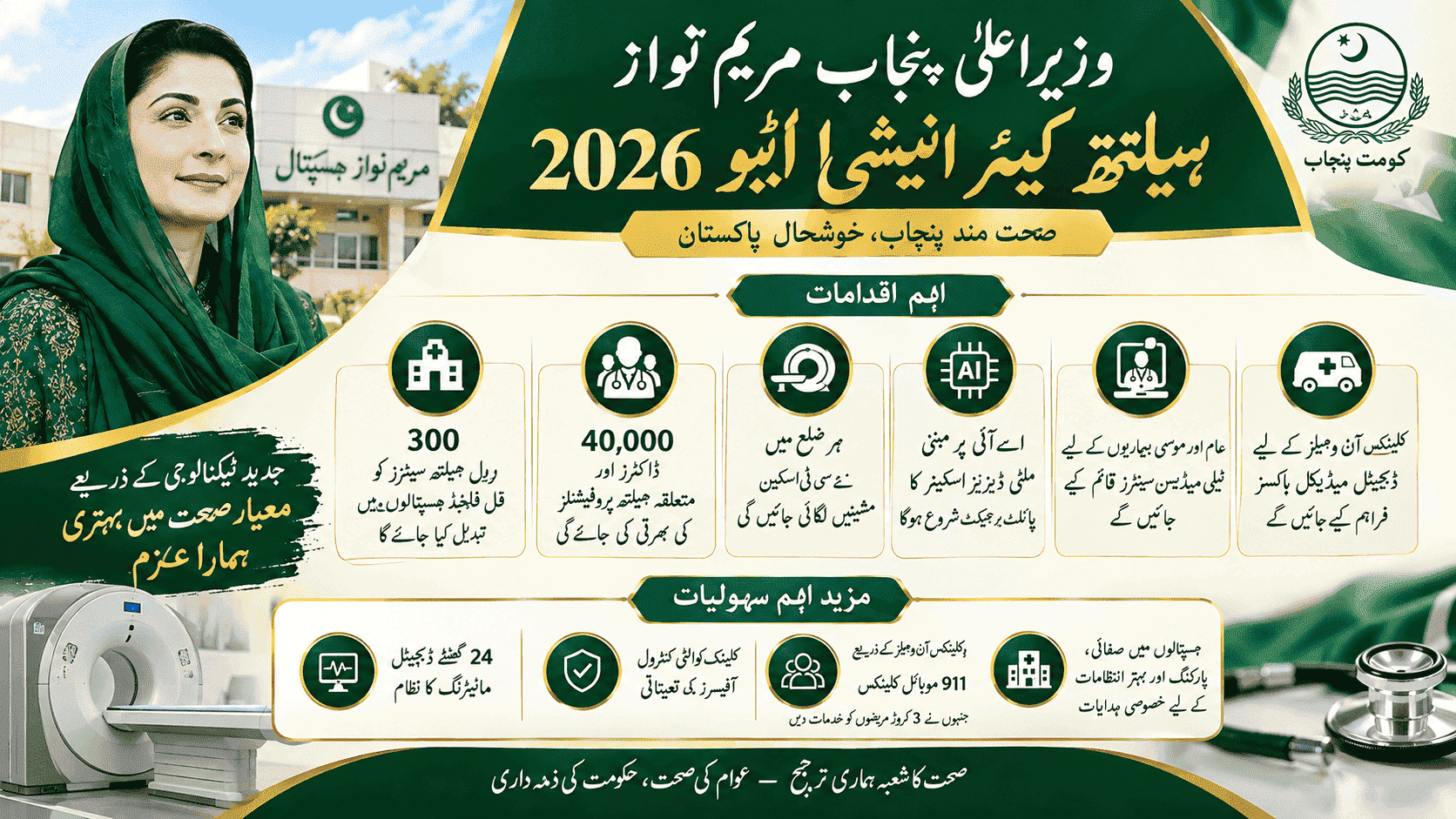
The Maryam Nawaz Healthcare Initiative 2026 brings together several major healthcare reforms announced for Punjab, including the conversion of 300 Rural Health Centres (RHCs) into full-fledged hospitals, recruitment of 40,000 doctors and allied health professionals, new CT scan machines for every district, telemedicine centres, digital medical equipment, and stronger hospital monitoring.
The latest announcement also introduced a monthly Hospital of the Month award to recognize outstanding performance in public hospitals. In a separate healthcare technology development, Punjab has also approved a pilot project for an AI-powered multi-disease scanner based on non-contrast CT technology. The proposed system could assist in screening multiple diseases and supporting earlier detection of serious health conditions.
Maryam Nawaz Healthcare Initiative 2026 – Key Details
| Key Detail | Information |
|---|---|
| Initiative | Maryam Nawaz Healthcare Initiative 2026 |
| Province | Punjab, Pakistan |
| Chief Minister | Maryam Nawaz Sharif |
| RHC Upgrades | 300 Rural Health Centres to be converted into full-fledged hospitals |
| Healthcare Recruitment | 40,000 doctors and allied health professionals planned |
| Hospital Award | Monthly Hospital of the Month award |
| CT Scan Expansion | New CT scan machines ordered for every district |
| AI Healthcare | AI-powered multi-disease scanner approved for a pilot project |
| AI Technology | Non-contrast CT-based screening solution |
| AI Screening Capability | Potentially up to 10 diseases within around two minutes |
| Telemedicine | Centres planned for common and seasonal diseases |
| Digital Medical Boxes | Planned for Clinics on Wheels |
| Digital Monitoring | 24-hour monitoring of public healthcare facilities |
| Quality Monitoring | Clinic Quality Control Officers to assess treatment quality |
| Clinics on Wheels | 911 mobile clinics reported to have served 30 million patients |
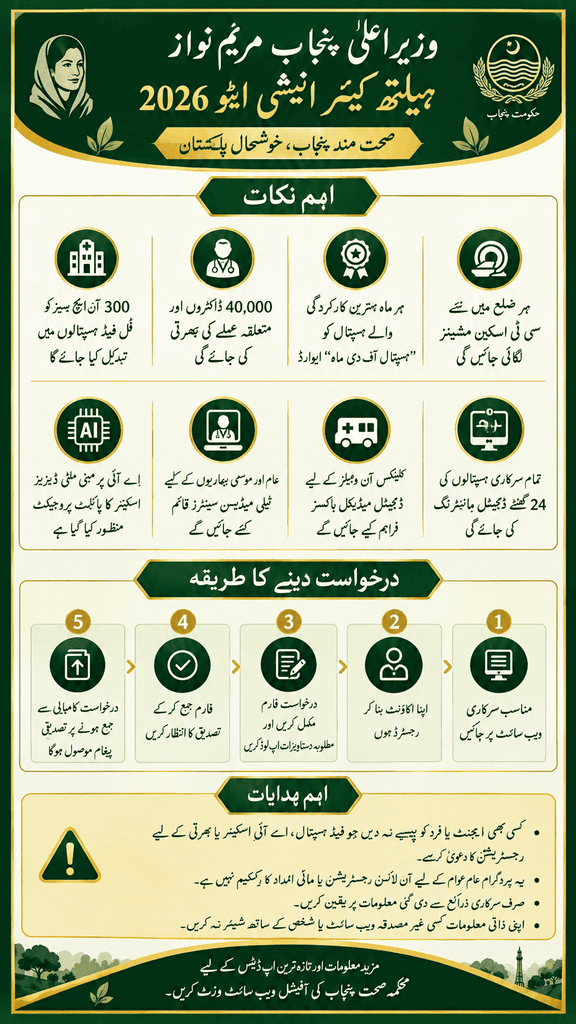
What Is the Maryam Nawaz Healthcare Initiative 2026?
The Maryam Nawaz Healthcare Initiative 2026 is not a conventional cash assistance scheme. It refers to a series of healthcare development and reform measures announced by the Punjab government.
The latest programme focuses on improving healthcare infrastructure, expanding medical staffing, increasing access to diagnostic services, introducing digital healthcare technology, and strengthening monitoring of government hospitals.
One of the central decisions is the conversion of 300 Rural Health Centres into full-fledged hospitals. The government has also directed the recruitment of 40,000 doctors and allied health professionals for hospitals across Punjab.
300 RHCs to Be Converted Into Full-Fledged Hospitals
The Punjab government has decided to convert 300 Rural Health Centres into full-fledged hospitals.
Rural Health Centres provide healthcare services to communities outside major urban areas. Their transformation into fuller hospital facilities is intended to expand the range of services available to people closer to their homes.
The announcement concerns a planned transformation and should not be interpreted as meaning that all 300 facilities have already completed their upgrades. Implementation will involve infrastructure, equipment, staffing, and operational arrangements.
Expected Improvements at Upgraded Facilities
The planned hospital upgrades may involve improvements in areas such as:
- Medical infrastructure
- Diagnostic facilities
- Healthcare staffing
- Patient services
- Emergency care
- Medical equipment
- Hospital management
- Monitoring and quality control
The exact services available at individual facilities may depend on the implementation plan and resources allocated to each location.
40,000 Healthcare Professionals Recruitment Plan
Another major component of the healthcare initiative is the planned recruitment of 40,000 doctors and allied health professionals across Punjab.
During the September 25 meeting, officials reported that several categories of healthcare workers had already been recruited or posted. These included doctors, women medical officers, consultants, cardiologists, lady health visitors, and support staff.
Healthcare Staff Reported in the Latest Briefing
The reported figures included:
- 2,524 doctors
- 2,482 women medical officers
- 408 consultants
- 32 cardiologists
- 7,572 lady health visitors
- 5,048 support staff
These figures were presented during the government briefing and should be understood as reported recruitment or posting figures at the time of the meeting.
Hospital of the Month Award
The Punjab government has announced a monthly Hospital of the Month award for hospitals demonstrating outstanding performance.
The award introduces a formal recognition mechanism for public healthcare facilities and forms part of the government’s wider focus on hospital performance and service quality.
Hospital Performance Monitoring
The latest healthcare meeting also included measures related to hospital administration and performance.
The chief minister ordered the replacement of medical superintendents at four hospitals over reported poor performance and negligence of duties. A pool of doctors and medical superintendents was also ordered for emergency situations.
AI-Powered Multi-Disease Scanner
Artificial intelligence is another important part of Punjab’s healthcare modernization plans.
In August 2026, Chief Minister Maryam Nawaz gave in-principle approval for introducing an AI-powered multi-disease scanner in Punjab and directed health authorities to prepare a pilot project.
The proposed system uses non-contrast CT technology and was presented as a tool that could assist healthcare professionals with disease screening, detection, diagnosis, treatment planning, and management.
According to the briefing, the technology could potentially screen for up to 10 diseases within around two minutes.
Diseases Mentioned in the AI Scanner Proposal
The reported capabilities include screening or assessment related to:
- Pancreatic cancer
- Liver cancer
- Gastric cancer
- Esophageal cancer
- Colorectal cancer
- Cardiovascular disease risks
- Acute Aortic Syndrome
- Osteoporosis
- Fatty liver
- Muscle and body-fat composition
The technology has been presented as an assistive diagnostic tool rather than a replacement for conventional medical diagnosis.
AI Scanner Status in Punjab
The AI scanner should currently be understood as a pilot-stage proposal, not as a service that is already available in every Punjab hospital.
Health authorities were directed to prepare a pilot project following the in-principle approval. Its wider implementation would depend on the outcome of the pilot and subsequent government decisions.
New CT Scan Machines for Every District
The Punjab government has also directed authorities to install new CT scan machines in every district of the province.
Expanding access to CT scanning could strengthen diagnostic facilities at district level and potentially reduce the need for some patients to travel to larger cities for imaging services.
However, the announcement is a direction for the installation of new machines. It should not be interpreted as confirmation that every district already has a newly installed machine.
Telemedicine Centres for Common Diseases
The healthcare plan also includes the establishment of telemedicine centres for common and seasonal diseases.
According to the reported plan, patients will be able to consult doctors through video calls. Where necessary, patients can be referred to the relevant hospital, ward, laboratory, or other healthcare facility. The centres are also expected to assist with appointments.
Potential Telemedicine Services
The planned centres can support:
- Online medical consultations
- Advice for common illnesses
- Seasonal disease consultations
- Hospital referrals
- Laboratory appointments
- Specialist referrals
Patients requiring emergency medical care should continue to use appropriate emergency healthcare facilities.
Digital Medical Boxes for Clinics on Wheels
The Punjab government has decided to introduce digital medical boxes for Clinics on Wheels.
The system is planned to support several diagnostic services through one setup, including:
- Ultrasound
- Blood sugar testing
- Complete blood count (CBC)
- ECG
A camera can also be connected to the digital medical box for teleconferencing, while a mobile-linked smart ultrasound device is also planned.
These technologies could increase the diagnostic capabilities of mobile healthcare services and make basic testing more accessible in areas served by Clinics on Wheels.
24-Hour Digital Hospital Monitoring
The Punjab government has also established a Directorate of Monitoring and Surveillance within Primary Healthcare to strengthen digital monitoring.
The reported monitoring system is intended to provide 24-hour digital monitoring of public healthcare facilities. The facilities covered include:
- District Headquarters Hospitals
- Tehsil Headquarters Hospitals
- Maryam Nawaz Hospitals
- Maryam Nawaz Health Clinics
- Field Hospitals
- Clinics on Wheels
Clinic Quality Control Officers
Another new measure is the appointment of Clinic Quality Control Officers.
These officers are intended to assess the quality of treatment being provided to patients. The initiative adds another layer of oversight to the broader hospital monitoring system.
Quality monitoring can help authorities identify issues involving treatment standards, patient services, facility management, and healthcare delivery.
Clinics on Wheels Healthcare Expansion
The latest briefing highlighted the reported performance of Punjab’s Clinics on Wheels programme.
According to officials, 911 mobile clinics provided healthcare services to around 30 million patients within a short period.
The planned introduction of digital medical boxes and smart ultrasound technology is expected to add further diagnostic capabilities to these mobile healthcare services.
Hospital Cleanliness and Patient Facilities
The latest healthcare meeting also included instructions to improve basic facilities at district and tehsil headquarters hospitals.
The directions included improvements to:
- Cleanliness
- Parking facilities
- Hospital management
- Patient services
These measures form part of the wider focus on improving healthcare delivery alongside infrastructure and technology upgrades.
What Patients Should Know
The Maryam Nawaz Healthcare Initiative 2026 is primarily a public healthcare development and reform programme. It is not a general cash-payment scheme requiring citizens to complete an online registration form.
Patients should therefore be careful about websites, social media posts, or individuals claiming that they can provide special registration for a healthcare payment under this initiative.
Any future registration process for a specific healthcare service should be verified through the relevant official Punjab government department.
Avoid Unofficial Registration Claims
Citizens should not pay an agent simply because someone claims to provide guaranteed access to:
- Maryam Nawaz Hospitals
- AI diagnostic services
- CT scan facilities
- Healthcare recruitment
- Telemedicine services
Official service requirements should be confirmed before providing personal information or paying any fee.
Current Status of the Healthcare Initiative
As of September 26, 2026, the healthcare measures are at different stages of implementation.
The Punjab government has announced the transformation of 300 RHCs into full-fledged hospitals, directed the recruitment of 40,000 doctors and allied health professionals, ordered new CT scan machines for every district, and announced telemedicine and digital monitoring measures.
The AI multi-disease scanner is at an earlier stage. It received in-principle approval in August 2026, and health authorities were directed to prepare a pilot project. Therefore, it should not currently be described as a fully deployed province-wide diagnostic service.
Further government announcements are expected to clarify implementation schedules, facility locations, staffing, equipment deployment, and the results of pilot projects.
Frequently Asked Questions
What is the Maryam Nawaz Healthcare Initiative 2026?
It is a collection of Punjab healthcare reforms involving hospital upgrades, healthcare recruitment, diagnostic expansion, telemedicine, digital medical technology, and stronger monitoring of public healthcare facilities.
How many RHCs will be converted into hospitals?
The Punjab government has announced plans to convert 300 Rural Health Centres into full-fledged hospitals.
How many healthcare professionals are planned to be recruited?
The government has directed the recruitment of 40,000 doctors and allied health professionals for hospitals across Punjab.
What is the Hospital of the Month award?
It is a monthly award announced for hospitals demonstrating outstanding performance across Punjab.
What is the AI multi-disease scanner?
It is a proposed AI-powered screening system based on non-contrast CT technology. According to the briefing, it could potentially screen for multiple diseases within around two minutes.
Is the AI scanner already available in all Punjab hospitals?
No. The available announcement describes it as a pilot project following in-principle approval. Province-wide availability has not been established by the announcement.
Will the AI scanner replace doctors?
No. The proposed system is intended to work alongside conventional diagnostic methods and provide healthcare professionals with an additional diagnostic tool.
Will every district receive a new CT scan machine?
The chief minister has directed authorities to install new CT scan machines in every district of Punjab. The announcement does not mean that all machines have already been installed.
Final Overview
The Maryam Nawaz Healthcare Initiative 2026 combines hospital infrastructure upgrades, healthcare workforce expansion, modern diagnostic technology, telemedicine, mobile healthcare, and digital monitoring.
The planned conversion of 300 RHCs into full-fledged hospitals and recruitment of 40,000 healthcare professionals are among the largest components of the latest healthcare announcement. The government has also ordered new CT scan machines for every district and introduced plans for telemedicine centres and digital medical boxes.
The AI-powered multi-disease scanner is a separate technology initiative that is currently associated with a planned pilot. Its proposed capabilities include faster screening and support for the early identification of multiple diseases, but it should not be presented as an already operational service throughout Punjab.
Overall, readers should treat the announced measures according to their current implementation status and rely on official government updates for specific hospital locations, recruitment opportunities, service availability, and future AI deployment.




Leave a Reply